
The rival to the Toyota Urban Cruiser EBELLA has entered the market. Here’s what we know so far.
Also read about the Maruti e Vitara’s Rival.
Maruti Suzuki e Vitara:
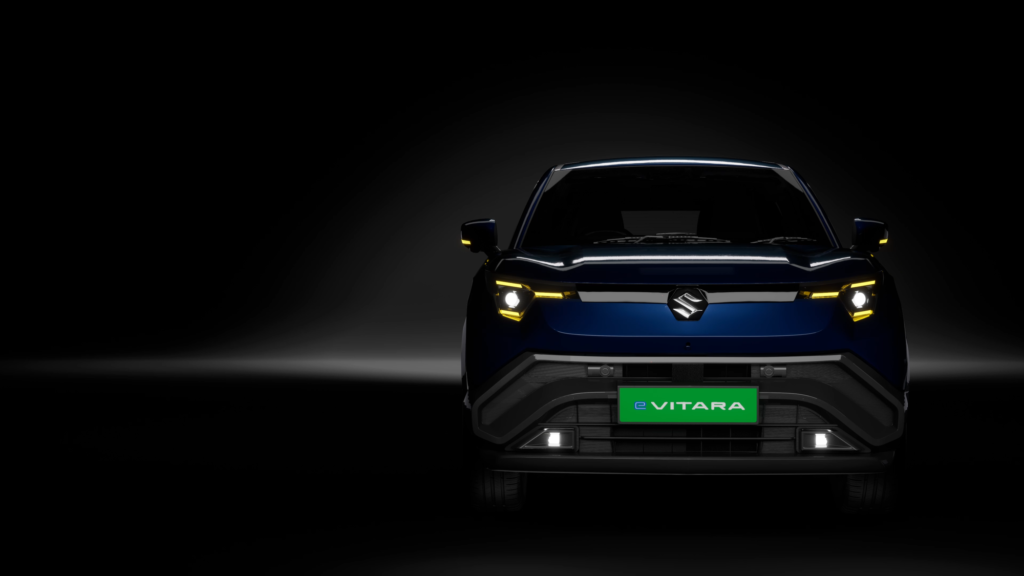
Maruti Suzuki has stepped into the electric SUV space with the e Vitara, a model that signals the brand’s serious long-term intent in India’s EV transition. Priced from ₹10.99 lakh under a battery-as-a-service ownership model, the new entrant aims to lower the barrier to electric mobility while offering practical incentives for early adopters. Buyers are being assured a 60 per cent buyback value after three years, along with a complimentary home charger installation and a year of public charging access at no additional cost. With production already underway at the company’s Gujarat facility and exports beginning simultaneously, the e Vitara is being positioned as both a domestic game-changer and a global product from India.
The SUV sits on a dedicated electric skateboard platform that allows for balanced proportions and generous cabin space. Measuring a little over 4.2 metres in length with a 2,700 mm wheelbase, it promises a spacious footprint suitable for family use while maintaining city-friendly dimensions. Ground clearance sits close to 185 mm, giving it a reassuring stance for Indian roads, and the 310-litre boot offers usable luggage capacity for everyday needs. The exterior palette is equally varied, with eleven colour options including dual-tone combinations and darker contrast roofs. This variety reflects Maruti Suzuki’s strategy of appealing to both traditional buyers and younger EV adopters seeking a modern design and flexible personalisation.
Visit the official Maruti India website.
Two lithium-iron-phosphate battery choices power the e Vitara, both sourced from established global suppliers. The smaller 48.8 kWh pack is paired with a motor producing 144 PS, while the larger 61.1 kWh version increases output to 174 PS. Torque remains consistent across both configurations, delivering a smooth and predictable driving experience. The larger battery claims a driving range of up to 543 km, positioning it competitively among current electric SUVs in the segment. Fast-charging capability allows the battery to replenish from 0 to 80 per cent in roughly 50 minutes using a DC rapid charger, making long-distance travel more manageable. Inside, the cabin integrates dual digital displays, connected-car features, powered seats and climate control, while Level 2 ADAS functions such as adaptive cruise control add a layer of advanced driver assistance.
Safety has been a central focus, with the e Vitara achieving a five-star rating in Bharat NCAP testing. High scores in both adult and child occupant protection highlight its structural strength and comprehensive safety kit. Standard equipment includes seven airbags, electronic stability control, ABS with electronic brakeforce distribution and ISOFIX mounts. With a strong feature list, flexible ownership model and an expanding charging network commitment from the manufacturer, the e Vitara arrives as a well-rounded electric SUV. It directly enters a competitive field populated by established and upcoming electric SUVs, but its blend of practicality, brand reach and ecosystem planning gives it a distinctive edge for Indian buyers considering a switch to electric mobility.
Comparison Table: e Vitara vs Key Rivals
| Model | Battery Options | Power Output | Claimed Range | Charging Capability | Key Highlights | Segment Positioning |
|---|---|---|---|---|---|---|
| Maruti Suzuki e Vitara | 48.8 kWh / 61.1 kWh | 144 PS / 174 PS | Up to 543 km | DC fast charge (0–80% ~50 min) | Battery subscription plan, strong safety rating, extensive service reach | New mass-market electric SUV |
| Hyundai Creta EV | ~45–55 kWh (expected) | ~138–170 PS | ~450–500 km (est.) | Fast charging supported | Familiar design, strong feature list, brand value | Premium compact EV SUV |
| Mahindra XEV 9e | ~60 kWh+ (expected) | ~200 PS+ | ~500 km+ (est.) | Fast charging supported | Futuristic styling, new-gen platform | Performance-focused electric SUV |
| MG ZS EV | ~50–60 kWh | ~176 PS | ~460 km | DC fast charging | Proven track record, spacious interior | Established EV option |
| Tata Curvv EV | ~55–60 kWh (expected) | ~150–170 PS | ~500 km (est.) | Fast charging supported | Coupe-SUV styling, modern features | Style-centric EV SUV |
Stay tuned and follow up for more.
