
Tata EV production increase 2026 India
More Tata EVs rolling out of the factory sounds like progress, and it is. But let us not confuse supply expansion with a solved problem.
More from us: Maruti e Vitara vs Hyundai Creta Electric 2026.
Tata’s Big Production Push
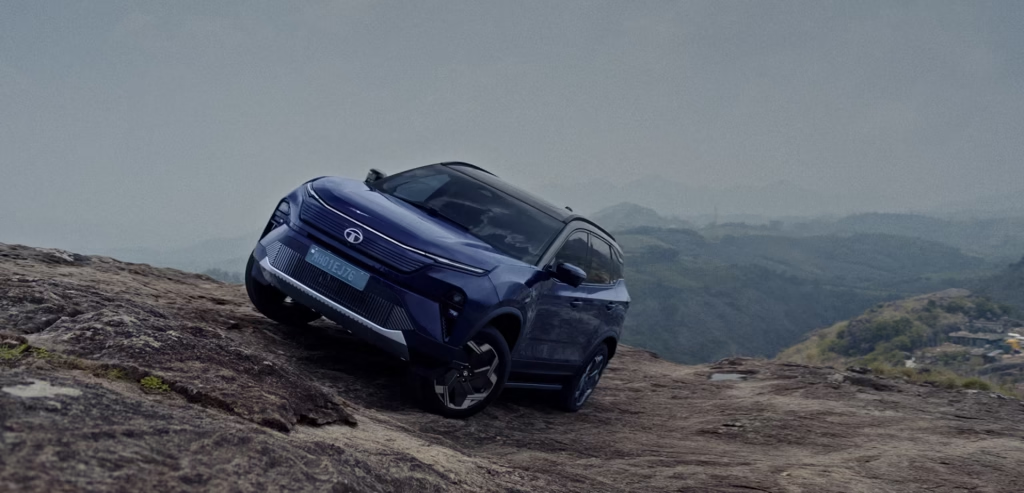
Tata Motors is planning to increase its EV production by 50 percent over the next three to four months. The company currently manufactures around 10,000 electric vehicles every month and is targeting an output of approximately 15,000 units monthly. This announcement came directly from Passenger Vehicles Managing Director Shailesh Chandra, and it is not a random target. It is a response to real market signals.
EV bookings at Tata have jumped 2 to 2.5 times over the past two months alone. The Nexon EV continues to be one of the best-selling electric cars in the country. The updated Tiago EV now starts at ₹6.99 lakh for outright purchase, and an aggressive Battery-as-a-Service option brings that entry price down to ₹4.69 lakh. EVs now account for nearly 30 percent of Tata’s total demand.
Why Demand Is Spiking Right Now
The timing of this surge is not a coincidence. Fuel prices have been climbing steadily, partly driven by the ongoing West Asia crisis, and daily running costs for petrol and diesel vehicles have become a real pain point for Indian buyers. When you are spending ₹8 to ₹10 per kilometre on fuel versus ₹1.5 to ₹2 per kilometre on electricity, the math starts making sense even for buyers who were previously sceptical.
Shailesh Chandra acknowledged this directly. Many buyers who might have postponed a purchase are instead reassessing their powertrain choice and moving towards EVs and CNG. For a family in a city like Ahmedabad or Pune doing 40 to 50 kilometres a day, the fuel savings on a Nexon EV over two years can comfortably offset the price premium over its petrol equivalent. The demand spike is real, and Tata is right to respond with more supply.
More EVs Does Not Mean the Problem Is Solved
Here is where the celebration needs to slow down. Tata ramping up production is good for the company and good for consumers who were stuck on long waiting periods. But it does not automatically mean that EVs are a full-fledged, all-conditions option for the average Indian buyer yet.
India’s climate alone is a serious variable that does not get discussed enough. Battery performance drops in extreme heat, and anyone who has driven through a waterlogged road in Mumbai during monsoon or sat in a car in Rajasthan in May knows that Indian conditions are not gentle. Range anxiety in summer is real. Battery degradation over time in high-temperature environments is a legitimate concern that manufacturers are still working to fully address for the Indian context.
Then there is the average Indian buyer’s mindset. A significant portion of car buyers in India are first-time owners or come from households where a car is a once-in-a-decade decision. For them, the idea of depending entirely on charging infrastructure that is still patchy outside metro cities is genuinely unsettling. Tata now supports access to over 26,000 charging points across India, which sounds impressive until you realise that most of those are concentrated in Tier 1 cities. Drive from Vadodara to a smaller town in Gujarat or take a road trip through Madhya Pradesh and the charging map gets thin very quickly.
Infrastructure Needs to Grow at the Same Speed
This is the core issue. Production expansion without matching infrastructure expansion is half a solution. The government and private players have been making progress, with ChargeZone, Tata Power, and others expanding networks. But the pace needs to match the ambition of putting 15,000 new EVs on the road every month.
To put it in perspective: India has roughly 26,000 charging points for a country of 1.4 billion people. The US has over 170,000 for a much smaller car-buying population. That gap is the real story. Fast-charging capability matters here too. The updated Tiago EV has seen a 40 percent improvement in fast-charging speed, which is a meaningful upgrade. But a buyer in a Tier 2 city still needs to know that the charger they drive to is functional, compatible with their car, and not occupied for the next two hours. Until that reliability exists across a wider geography, EVs will remain a confident choice for urban buyers and a risk for everyone else.
What This Means for Indian Buyers
If you are a city commuter doing under 60 kilometres a day with access to home charging or a workplace charger, the case for a Tata EV right now is stronger than it has ever been. The Tiago EV at ₹4.69 lakh via BaaS is arguably the most disruptive EV price point in India today. Fuel savings will be real and consistent. But if you need an EV as your only vehicle for mixed city and highway use, or if you live in a Tier 2 or Tier 3 city without reliable charging access, the honest advice is to wait another 12 to 18 months for the infrastructure to catch up.
Final Verdict
Tata’s EV production increase in 2026 is the right call for India. The demand is there, the urgency around fuel prices is real, and more supply means shorter wait times and potentially more competitive pricing over time. But let us not get carried away. Production numbers going up does not mean every Indian buyer is ready for an EV, and more importantly, it does not mean India’s roads and charging network are ready for every Indian buyer.
The EV transition in India is happening, just not uniformly. It is thriving in cities and struggling at the edges. Tata scaling up is one piece of a much larger puzzle, and the infrastructure side of that puzzle needs the same urgency that the production side is currently getting.
Frequently Asked Questions (FAQs)
Q1. What is Tata’s EV production increase target for 2026 in India?
Tata Motors plans to increase its EV production by 50 percent, from around 10,000 units per month to approximately 15,000 units per month, over the next three to four months. This ramp-up is a direct response to a 2 to 2.5 times increase in EV bookings driven by rising fuel prices.
Q2. Is the Tata Tiago EV actually affordable for a middle-class Indian buyer in 2026?
Yes, more than ever. The Tiago EV starts at ₹6.99 lakh for outright purchase, but under the Battery-as-a-Service model the entry price drops to ₹4.69 lakh, making it the most accessible electric car in India right now. Combine that with running costs of around ₹1.5 per kilometre and the ownership case becomes very strong for city commuters.
Q3. Is buying a Tata EV practical for Indian road conditions and climate?
For city buyers with home or workplace charging access, yes. But India’s extreme heat, monsoon conditions, and limited charging infrastructure outside metro cities remain real challenges. Battery performance in high temperatures and charging availability on highway routes are factors worth considering before buying.
Q4. Should I buy a Tata EV now or wait for better infrastructure?
If you are an urban commuter doing under 60 kilometres daily, buy now. The running cost savings justify it. If you need the car for long highway drives or live in a city with limited charging access, waiting 12 to 18 months for infrastructure to improve is the smarter move.
Stay tuned and follow up for more.
