
Table of Contents
The Maruti Fronx hit 20,686 units in May 2026. The Tata Nexon hit 19,100. The Maruti Fronx vs Tata Nexon 2026 comparison is not about which one is popular. Both clearly are. It is about which one is actually right for you.
More from us: Kia Sonet 1 Star NCAP Rating: Should You Still Buy It in 2026?
Why Both Cars Deserve to Be on Your Shortlist
The Fronx and Nexon are the two fastest-growing compact SUVs in India this year. The Fronx grew 52 percent year-on-year in May 2026, the Nexon 46 percent. That kind of growth in a segment already packed with strong rivals means these cars are actively winning over buyers who looked at everything else and still came back to these two. The Fronx starts at ₹7.79 lakh and the Nexon at ₹7.37 lakh ex-showroom, so the entry-point difference is barely noticeable. Where they actually separate is in what you get from your money and how each car behaves across the full range of Indian usage patterns, from daily city commutes to family highway runs.
Design, Size and Daily Practicality
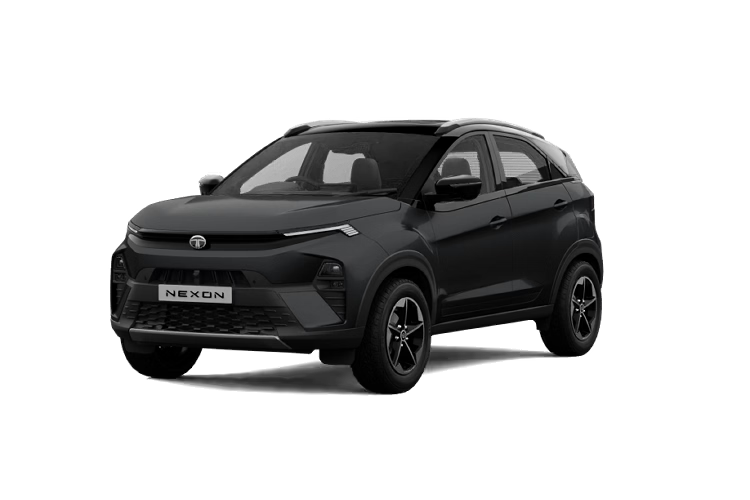
The Fronx is a coupe-crossover. It is shorter and lower-slung than a traditional compact SUV, which gives it a genuinely modern look that stands out in this segment. That compact footprint pays real dividends in city traffic: tighter turning radius, easier to slot into parking spots, and more confidence in congested lanes. The Nexon is a proper compact SUV with a taller stance, more body height, and a larger cabin with noticeably better rear headroom. For a daily commuter in Mumbai or Bengaluru covering 40 to 50 km through heavy traffic, the Fronx is simply the easier car to use. For a family running the car as their primary vehicle with monthly highway trips factored in, the Nexon’s road presence and ground clearance make it the better fit. These are not small differences. They are the whole decision.
Safety, Features and Where the Gap Opens Up
The Nexon holds a 5-star Bharat NCAP rating, the highest possible score under India’s own crash testing programme. If safety is a priority in your household, nothing in this price range matches it. The Fronx has not published a comparable score from independent crash testing, which means safety-first buyers have a clear answer before even looking at the spec sheet. On features, the picture is closer. Upper trims of the Fronx include a heads-up display, a large touchscreen, connected car technology, and a sunroof, matching the Nexon’s feature set step for step. However, the Nexon offers something the Fronx cannot: CNG and electric powertrain variants. If you are buying a petrol car today but think you might switch to CNG in the next two years, the Nexon keeps that door open. The Fronx does not. In the ₹8 to ₹11 lakh range, the Fronx generally delivers slightly more features per rupee at equivalent trims.
Mileage, Maintenance and the Maruti Factor
This is where the Fronx builds a real, practical case. Its 1.2-litre petrol engine delivers better real-world fuel efficiency than the Nexon petrol in city conditions, which matters significantly when you are calculating three to five years of running costs. More importantly, Maruti’s service network is the largest in India by a considerable margin. In cities like Surat, Jaipur, Nagpur, and Coimbatore, a Fronx owner gets faster service turnarounds, lower labour costs, and better parts availability than a Nexon owner in the same city. For buyers searching for the best compact SUV under 12 lakh India 2026, the total cost of ownership over five years is often the deciding factor, not the sticker price. Tata’s service network has genuinely improved in recent years, but it still trails Maruti in tier-2 and tier-3 city coverage.
What This Means for Indian Buyers
The Maruti Fronx vs Tata Nexon 2026 decision splits cleanly by buyer type. City commuter who drives primarily in metro traffic, values fuel efficiency, and wants a car that is cheap and simple to maintain: buy the Fronx. Family buying a primary car that will carry four people on regular highway runs, where safety ratings and rear cabin space matter: buy the Nexon. First-time SUV buyer with a ₹9 to ₹11 lakh budget who has not decided yet: go to the dealership and sit in the back seat of both cars before you make a call. The Nexon’s rear headroom advantage either matters to your family or it does not, and that one check will settle things.
Final Verdict
There is no universal winner here. The Maruti Fronx vs Tata Nexon 2026 comparison rewards buyers who are honest about how they use their car. Buy the Fronx if you are a city-first buyer who wants a stylish, efficient, low-maintenance crossover in the ₹9 to ₹11 lakh range. Buy the Nexon if the 5-star safety score is non-negotiable for you, or if you want the flexibility of CNG or electric options down the line. Do not let either car’s sales rank make the decision for you. Popularity and fit are two different things.
Frequently Asked Questions
Q1. Which is better in 2026, the Maruti Fronx or Tata Nexon?
There is no single answer. The Fronx is better for city driving, mileage, and lower running costs. The Nexon is better for safety, rear cabin space, and powertrain flexibility including CNG and EV. Your usage pattern decides which one wins for you.
Q2. What is the price difference between Fronx and Nexon in 2026?
The Maruti Fronx is priced from ₹7.79 lakh to ₹13.77 lakh ex-showroom. The Tata Nexon ranges from ₹7.37 lakh to ₹14.02 lakh. Both cars sit in a similar price band and overlap significantly in the ₹9 to ₹12 lakh range where most buyers compare them.
Q3. Does the Maruti Fronx have a safety rating?
The Fronx has not published a score from independent crash testing that matches the Nexon’s record. The Tata Nexon holds a 5-star Bharat NCAP rating, giving it a clear and verified safety advantage. For buyers making a direct comparison on crash safety, the Nexon wins this category without debate.
Q4. Which gives better mileage, the Fronx or the Nexon?
The Fronx has the mileage advantage. Its 1.2-litre petrol delivers better real-world fuel efficiency compared to the Nexon’s petrol engine, particularly in city driving conditions. For buyers who drive 1,500 km or more per month, this difference adds up to a meaningful saving over a full ownership cycle.
Stay tuned and follow up for more.
