
Kia Battery as a Service India
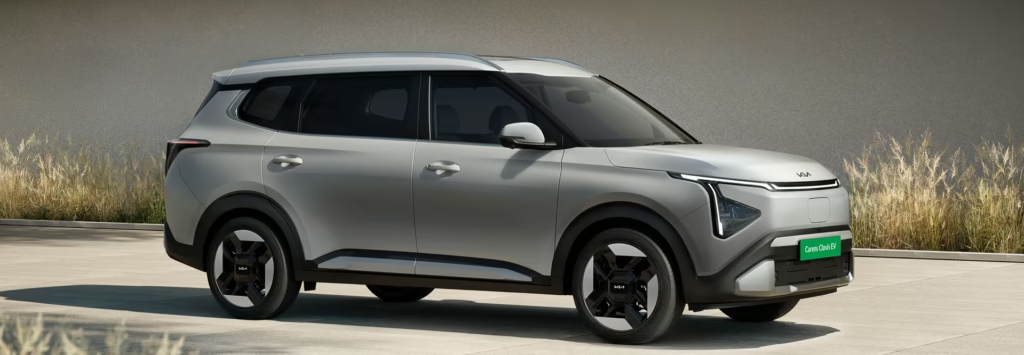
The Kia Carens Clavis EV starts at ₹12.84 lakh. For an electric MPV from a Korean brand with rear sliding seats and a feature-loaded cabin, that price sounds almost too good. It is, sort of. At ₹12.84 lakh, you are not buying the battery. You are renting it.
This is Kia Battery as a Service India, commonly called BaaS. It is one of the more interesting financial structures to enter the Indian EV market, and it deserves a proper breakdown before you sign anything.
More from us: Kia Syros EV India 2026: Everything You Need to Know Before It Launches.
What Is Battery as a Service, Exactly?
BaaS separates the vehicle from the battery at the point of purchase. You buy the car body, the motor, and all the hardware. The battery pack is owned by Kia or a leasing partner, and you pay a fixed monthly rental fee to use it. The ownership contract for the vehicle and the rental contract for the battery run concurrently.
The logic is straightforward. EV batteries are expensive, typically accounting for 35 to 45% of the total vehicle cost. By removing the battery from the sticker price, the upfront number drops significantly. In the case of the Carens Clavis EV, the Carens Clavis EV BaaS price of ₹12.84 lakh is several lakhs lower than what a full ownership variant would cost. Your EMI is lower, your down payment is more manageable, and the entry point into EV ownership feels far less intimidating.
On paper, it looks like a logical route for a first-time EV buyer. The reality is more nuanced.
The Numbers You Actually Need to See
The Carens Clavis EV BaaS price starting at ₹12.84 lakh is the headline. But your monthly outgoing does not stop there.
Assume the full ownership version of the Clavis EV is priced around ₹16 lakh. The BaaS version saves you approximately ₹3.16 lakh upfront. On a standard 5-year car loan at 9% interest, that translates to roughly ₹3,200 to ₹3,500 less in EMI every month compared to the full ownership route.
Now add the monthly battery rental. BaaS rental rates in India, based on comparable schemes running in markets like China and early Indian pilots, typically fall between ₹2,500 and ₹4,500 per month depending on battery size and contract duration. If Kia’s BaaS rental sits at ₹3,500 per month for the Clavis EV battery, your net saving over the full ownership route is somewhere between zero and ₹1,000 per month. That is before you consider what happens at the end of the contract.
If you are looking at BaaS purely because the sticker price looks attractive, the monthly maths is not as clean as the showroom conversation will make it sound.
Where BaaS Makes Genuine Sense
BaaS does have a real use case. It is just a specific one.
If you live in a metro like Mumbai or Delhi, plan to use the car primarily for city commuting, and intend to upgrade your vehicle every three to four years, BaaS can work in your favour. You take on lower upfront costs, benefit from reduced EMIs, and hand the car back before battery degradation becomes a meaningful concern. The battery liability never fully becomes yours, and for buyers with shorter ownership cycles, that is a legitimate financial advantage.
Corporate fleet operators and high-mileage users are an even stronger fit. A driver covering 150 to 200 km per day will degrade a battery pack significantly faster than a household user doing 40 km daily in Pune. Under BaaS, that accelerated degradation risk belongs to the battery owner, not you. The best EV for first-time buyer India 2026 arguments often focus on acquisition cost, and BaaS does address that concern directly for urban short-cycle buyers.
Where BaaS Becomes a Problem
The typical Indian family buys a car and keeps it for seven to ten years. If that describes your household, BaaS is likely a worse financial decision than full ownership.
Over a 7-year period, the cumulative monthly rental fees will almost certainly exceed the original battery cost. You end up paying more in total for a component you never actually own. The battery rental EV India equation only favours buyers when the rental period is short enough that the accumulated fees do not surpass the battery’s purchase value.
Resale is the second issue, and in India this one stings. When you go to sell a BaaS vehicle, you are selling a car without a battery. The buyer either needs to assume the rental contract, negotiate a battery purchase at whatever the market rate is at that point, or walk away. This does not happen smoothly at a used car dealer, and it significantly limits your pool of potential buyers. In a market where resale value is a key part of the ownership calculation for most households, BaaS puts you at a structural disadvantage the moment you decide to sell.
What This Means for Indian Buyers
Kia Battery as a Service India is not a scam. It is a product built for a specific buyer profile, and sold aggressively to a broader one. Before you choose BaaS over full ownership, calculate the total cost of ownership for your actual planned ownership period, not the showroom pitch. If you are keeping the car under five years, BaaS may genuinely save you money. Beyond that, you are most likely paying more across the life of the vehicle and getting less back when you sell.
Final Verdict
Kia Battery as a Service India deserves credit for bringing a lower entry price to the electric MPV segment and making it accessible to buyers who previously could not afford the upfront cost. But the deal is only clean if your ownership horizon is short. Run the numbers for your specific situation before the conversation reaches the finance desk. Know what you are signing, know how long you plan to keep the car, and know that resale under BaaS is a more complicated conversation than the brochure suggests.
Frequently Asked Questions
Q1. What is Kia Battery as a Service India?
Kia Battery as a Service India is a scheme where you purchase the Carens Clavis EV without owning the battery. You pay a lower upfront price starting at ₹12.84 lakh and then rent the battery on a monthly basis. It is designed to lower the cost barrier to EV ownership for first-time buyers.
Q2. What is the Carens Clavis EV BaaS price?
The Carens Clavis EV BaaS price starts at ₹12.84 lakh (ex-showroom), which covers the vehicle without the battery. A separate monthly rental fee is charged for the battery, though Kia has not publicly listed the exact rental amount for India yet.
Q3. Is battery rental EV India a good idea for long-term buyers?
For buyers planning to hold the vehicle for seven years or more, battery rental EV India schemes generally cost more in total than full ownership would. Accumulated rental fees exceed the battery’s purchase cost over time, and resale value is weaker because the car is sold without its battery.
Q4. Should I choose BaaS or full ownership for the Carens Clavis EV?
Choose BaaS if you plan to own the car for three to five years and primarily use it for urban commuting. Choose full ownership if you intend to keep it longer, drive it on highways regularly, or expect strong resale value when you sell. Run the total cost calculation before you decide.
Stay tuned and follow up for more.
