
Honda ZR-V no sunroof 2026
Honda is about to launch its most expensive SUV ever sold in India, expected to be priced between ₹40 lakh and ₹50 lakh, and it has confirmed something that should make every showroom salesperson nervous. The Honda ZR-V no sunroof 2026 decision is now official. At a price point where the Volkswagen Tiguan, Skoda Kodiaq, and Jeep Meridian all offer some form of sunroof, Honda’s flagship import arrives without one. The question worth asking is not whether this is unusual, it clearly is, but whether it actually matters as much as Indian buyers think it does.
More from us: Tata EV Discount June 2026: Why Cut Prices Right After Your Best Month Ever
What the ZR-V Gets Instead
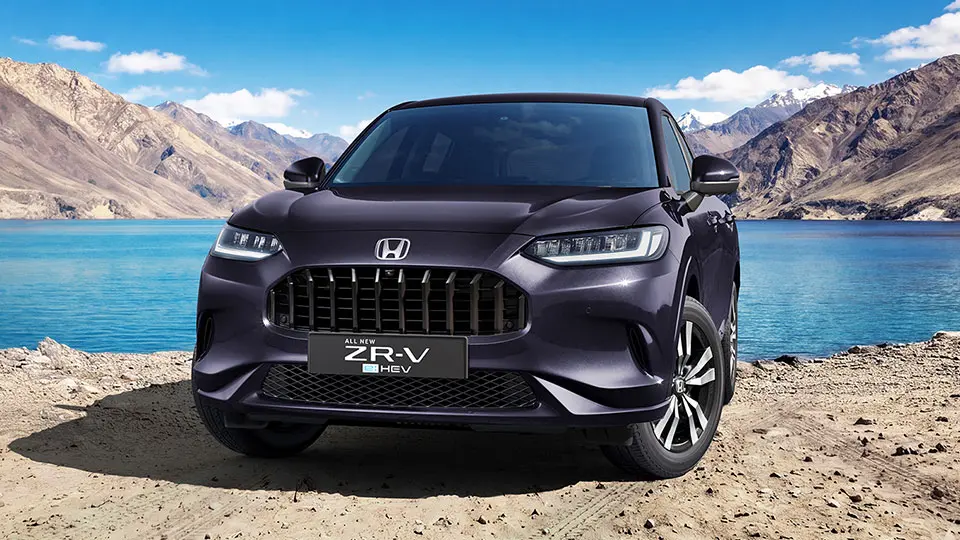
This is not a stripped down SUV missing features across the board. The ZR-V comes to India fully imported as a CBU, powered by a 2.0-litre strong hybrid setup producing 184 hp and 315 Nm, paired with an e-CVT and claiming 22.8 kmpl, a genuinely strong efficiency number for a car this size. It gets six airbags as standard, a 10.1-inch digital instrument cluster, a powered tailgate, two-zone climate control, powered front seats, and wireless phone charging. The cabin uses leatherette upholstery with contrast stitching and a minimalist dashboard that leans into Honda’s recent design language rather than chasing screen count for its own sake. On paper, this is a car built around mechanical confidence and hybrid efficiency, not a checklist of cabin gadgets.
Why the Sunroof Obsession Exists in the First Place
Indian car buying culture treats the sunroof as a status symbol almost more than a functional feature, largely because it became a differentiator during the years when compact SUVs needed something visible to justify a price jump over hatchbacks. That logic made sense at the ₹8 lakh to ₹15 lakh level, where a sunroof genuinely separated a loaded variant from a base one. At ₹40 lakh, the buyer’s psychology is different. Nobody cross-shopping a ZR-V is choosing it because of the sunroof on a rival; they are choosing between brand trust, ownership cost, and how the car drives. Yet showroom conversations rarely reflect that nuance, and “no sunroof” becomes a talking point disconnected from how the car is actually used.
Does It Actually Cost Honda Sales?
It will cost Honda some sales, there is no honest way around that. A meaningful slice of premium SUV buyers in India treat a panoramic sunroof as non-negotiable regardless of logic, and Honda is choosing brand positioning over chasing that exact buyer. But the ZR-V was never going to win on volume. It is positioned as a halo model, a CBU import meant to rebuild Honda’s premium credibility in India after years of a fairly quiet SUV lineup. For that specific goal, a hybrid powertrain story and genuine driving refinement matter more than a glass roof. Honda appears to be betting that the buyer who actually cross-shops a Tiguan or Kodiaq at this price is shopping on substance, not on a single feature line.
What This Means for Indian Buyers
If a sunroof is a hard requirement for you at this price point, the ZR-V is simply not your car, and no amount of hybrid efficiency will change that. But if you are genuinely comparing real-world running costs, the ZR-V’s 22.8 kmpl claimed mileage against the Kodiaq’s 14.86 kmpl and the Tiguan’s 12.58 kmpl is not a small gap, it compounds meaningfully over years of ownership for someone doing 15,000 to 20,000 km annually. For a buyer in a city like Bengaluru or Pune doing daily long commutes, that fuel saving could matter more over five years than a feature you might use a handful of times a year.
Final Verdict
The Honda ZR-V no sunroof 2026 decision is a deliberate trade off, not an oversight, and Honda is clearly betting on hybrid efficiency and brand rebuilding over chasing every feature checkbox. Buyers who treat a sunroof as non-negotiable should look elsewhere without hesitation. Buyers who care more about real-world running costs, hybrid reliability, and Honda’s service network should not let this one omission override what is otherwise a genuinely well specified, efficient flagship SUV. With launch confirmed for June 20, this becomes a real decision in days, not months.
Frequently Asked Questions
Q1. Is the Honda ZR-V no sunroof 2026 confirmed officially?
Yes, Honda has confirmed the ZR-V will not be offered with a sunroof in India, a notable absence at its expected ₹40 lakh to ₹50 lakh price point. This applies across all variants, not just the base trim.
Q2. When does the Honda ZR-V launch in India?
The ZR-V is expected to launch in India around June 20, 2026, with customer deliveries beginning in July 2026. It comes to India as a fully imported CBU model.
Q3. How does the ZR-V’s mileage compare to its rivals?
The ZR-V claims 22.8 kmpl thanks to its strong hybrid powertrain, well ahead of the Skoda Kodiaq’s 14.86 kmpl and the Volkswagen Tiguan’s 12.58 kmpl. For high-mileage owners, this difference adds up significantly over years of ownership.
Q4. Should I buy the Honda ZR-V despite no sunroof?
If a sunroof is a deal breaker for you, skip it and look at the Tiguan or Kodiaq instead. If you prioritise hybrid efficiency, refinement, and Honda’s service reputation, the missing sunroof should not be a reason to walk away.
Stay tuned and follow up for more.
