
CAFE III norms India 2027 explained
Also visit the official website of Ministry of Power
If you still read that India’s next fuel-efficiency rules are being debated, those reports are out of date. Here are the CAFE III norms India 2027 explained in one line: final rules are notified, and each carmaker’s fleet-average fuel target falls 16.7 per cent by 2032.
What Was Notified, and When
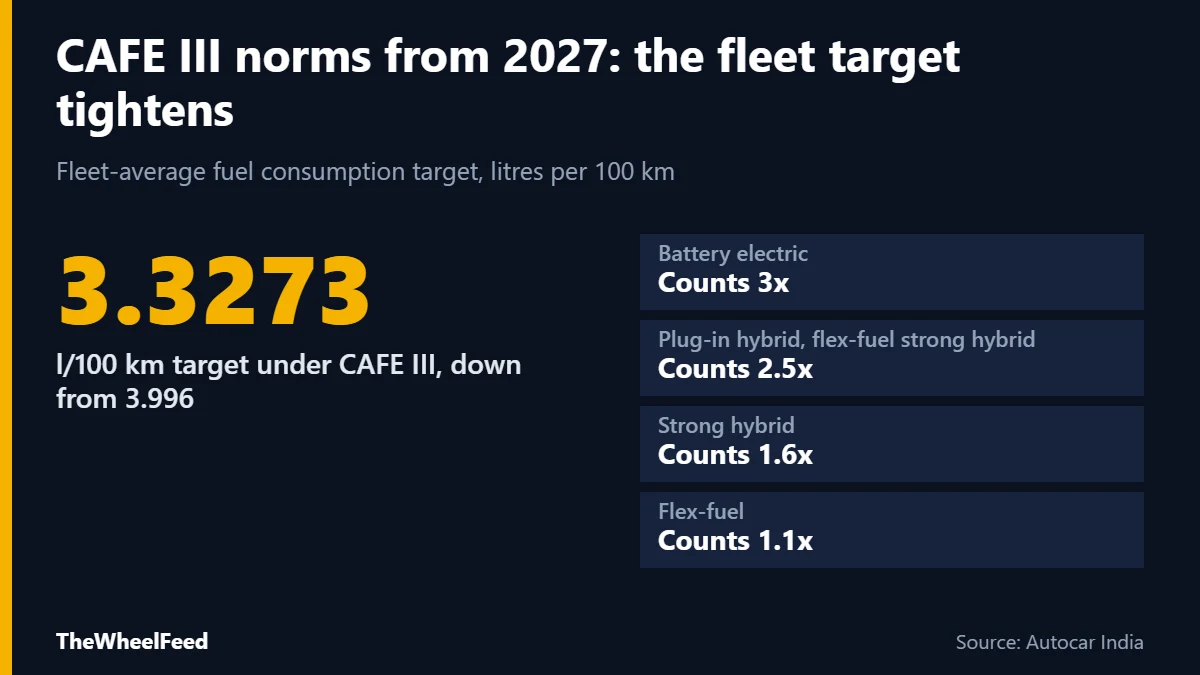
CAFE III is India’s fuel-efficiency rulebook for new passenger cars from 1 April 2027 to 31 March 2032. The Ministry of Power notified it at the end of September 2026, and reports date the notification 29 or 30 September. Each fleet average must fall from 3.996 to 3.3273 litres per 100 km at the reference weight, with EVs and hybrids earning extra credits.
All India Radio reported the notification on 30 September. The draft stage, with carmakers split over a weight-based relief, is over. Our conversion of the targets: roughly 25 km/l tightening to 30 km/l on the lab cycle, a fleet average and not a promise for any single car. CAFE IV for 2033 to 2037 has been floated in earlier proposals but is not notified, so ignore anyone treating it as settled.
How the Weight Formula Treats Small Cars
The biggest surprise in the CAFE III norms India 2027 explained here is what small cars did not get. The September 2025 draft offered an extra 3 g/km allowance to petrol cars under 909 kg, 1,200 cc and four metres. The final rules drop it and flatten the weight curve instead.
Targets are set per manufacturer on the average weight of the cars it sells, around a 1,229 kg reference. Our calculation from the published examples: each extra 100 kg of fleet weight adds about 3.75 g/km to the allowed CO2. A 909 kg fleet gets about 82.8 g/km in 2027-28 and a 2,500 kg fleet about 142.4 g/km, per Free Press Journal.
Maruti and Toyota had backed small-car relief, while Tata, Mahindra, Hyundai and Kia opposed it. Maruti has since welcomed the final framework.
EVs, Hybrids and the Credit Multipliers
Autocar India lists the multipliers: battery and range-extended EVs count as 3, plug-in hybrids and flex-fuel strong hybrids as 2.5, strong hybrids as 1.6 and flex-fuel cars as 1.1. Strong hybrids sat at 2.0 in an earlier draft, so that incentive was trimmed.
Carmakers can earn up to 9 g/km from efficiency technology. Surplus credits can be traded, or bought from BEE at ₹2,500 per g/km in 2027-28, rising to ₹4,500 by 2031-32. Compliance runs in two blocks, 2027-28 to 2029-30 and 2030-31 to 2031-32, and makers selling under 1,000 vehicles a year are exempt from the target.
That is why we expect more efficiency tech on petrol cars, plus more plug-in hybrids like the one in our JSW Combat price report. Industry reaction was calm: Mahindra called the framework pragmatic, and Hyundai said it plans a green portfolio above 50 per cent within four to five years, per Autocar Professional.
What Changes for Buyers
No official price impact has been published, so any “₹1 lakh costlier” headline is a guess. Autocar India’s example is that a ₹20,000 to ₹30,000 technology addition is easier to absorb on a premium SUV than on an entry hatchback.
From April 2027 carmakers must declare CO2 under both MIDC and WLTP, with the conversion factor still to be notified. Brochure mileage numbers may therefore shift. Diesel and CNG also earn credits for biofuel and biogas blending, so neither is written off. Think of CAFE as a push on the heaviest fleets, not a petrol ban.
What This Means for Indian Buyers
If you drive 15,000 km a year in Bengaluru traffic and your next car is 20 per cent more efficient than the old one, you burn about 100 litres less. At an assumed ₹100 a litre, that saves about ₹10,000 a year. Those are our numbers, not an official forecast.
The rules also stack with the proposed BS7 norms for 2029 and the draft mandatory AEB rule. Entry cars will carry more hardware, and that cost usually reaches the price tag.
Final Verdict
The CAFE III norms India 2027 explained here are final, not a draft, and they are firmer on heavy SUVs than on hatchbacks. Buy the car you need today, because nothing changes for existing owners. If you plan to buy in 2028 or later, shortlist a strong hybrid or an EV, since carmakers will push those hardest. Do not panic buy before April 2027, as no official price rise has been announced.
When do CAFE III norms start in India?
CAFE III norms start on 1 April 2027 and run until 31 March 2032. The Ministry of Power notified them at the end of September 2026. They apply to new passenger cars made or imported for sale in India.
Do CAFE III norms make cars more expensive?
No official estimate exists yet. Carmakers will add efficiency technology, which costs money, and entry hatchbacks have the least room to absorb it. The flatter weight curve eases that pressure on lighter fleets.
CAFE III norms India 2027 explained: do small cars get any relief?
Not a separate one. The 3 g/km allowance proposed in the September 2025 draft was dropped, but the flatter weight curve gives lighter fleets softer targets than heavy ones. Maruti said it welcomed the final framework.
Are EVs and hybrids favoured under CAFE III?
Yes. Battery EVs count three times in the fleet average, plug-in hybrids and flex-fuel strong hybrids 2.5 times, and strong hybrids 1.6 times. That is why more electrified cars are likely over the next five years.
Stay tuned and follow up for more.
