
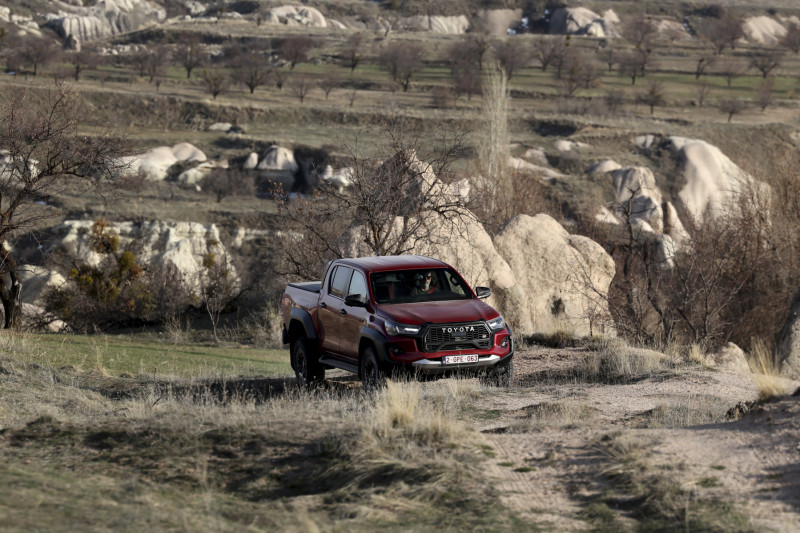
New Gen Toyota Hilux debuts with new powertrains, that includes a new EV powertrain and a Hydrogen powertrain to be debut later. Here’s what we know so far.
EV Powertrain:
The new-generation Toyota Hilux features a cutting-edge electric powertrain that marks Toyota’s first fully battery electric version of this iconic pickup. It is equipped with a 59.2 kWh lithium-ion battery pack positioned under the floor to optimize space and stability. The powertrain utilizes front and rear eAxles, delivering a combined system output of approximately 144 kW (around 193 hp) and providing permanent all-wheel drive. The electric motors generate torque values of 205 Nm at the front and 268.6 Nm at the rear, which support excellent off-road capabilities aided by a Multi-Terrain Select system for adapting to various terrains. The drivetrain preserves Hilux’s renowned toughness with robust body-on-frame construction and maintains a water wading depth comparable to diesel versions. It boasts a WLTP estimated range of approximately 240 km per charge, targeting practical daily use and fleet requirements without compromising payload capacity or towing ability. This EV powertrain represents Toyota’s step towards sustainable mobility while retaining the Hilux’s legacy of durability and practicality in diverse conditions.
ICE Powertrain:
The new-generation Toyota Hilux is equipped with a robust 2.8-liter turbo-diesel internal combustion engine that delivers strong performance tailored for both on-road and off-road applications. This 4-cylinder engine produces approximately 201 horsepower at 3000-3400 rpm and a peak torque of 500 Nm between 1600-2800 rpm, offering excellent low-end grunt crucial for towing and hauling. The Hilux engine is paired with a 6-speed automatic transmission, enhancing smooth gear shifts and improved drivability.
Take a look at The Toyota Hilux on the Official Toyota Website.
Its 2755 cc diesel engine conforms to modern emission standards while balancing power with fuel efficiency, delivering around 10-13 kmpl depending on driving conditions. The engine layout is an inline configuration designed for durability and ease of maintenance, suitable for the heavy-duty use expected from a pickup truck. The Hilux’s powertrain also includes advanced technologies such as locking differentials and 4WD capabilities for superior traction on challenging terrains. Overall, this ICE powertrain strikes a commendable balance between performance, reliability, and fuel economy, making it versatile for diverse driving needs and tough environment.
Hydrogen Powertrain: New Gen Toyota Hilux
The new-generation Toyota Hilux is set to introduce a hydrogen fuel cell powertrain version by 2028, showcasing Toyota’s commitment to clean energy and hydrogen technology. This hydrogen-powered Hilux replaces the conventional internal combustion engine with a fuel cell stack similar to that of the Toyota Mirai sedan. It features three high-pressure hydrogen storage tanks integrated into the vehicle’s structure, enabling an extensive driving range of up to 600 km.
The electric motor powering the vehicle draws electricity generated by the fuel cell, storing energy in a small battery positioned in the load bay for regenerative braking and one-pedal driving capabilities. This fuel cell electric vehicle (FCEV) variant maintains Hilux’s renowned ruggedness, durability, and off-road capability, with design enhancements like underbody protection and robust tires for enhanced terrain handling. The introduction of the hydrogen powertrain aligns with Toyota’s multi-pathway strategy towards carbon neutrality, aiming to provide fleet and commercial users with a zero-emission, practical, and highly capable pick-up truck option for the future. This complements the broader Hilux lineup, which includes battery electric and hybrid models, underscoring Toyota’s diverse electrification approach.
Read about The Fortuner Leader Edition.
Competition:
| Competitor Model | Segment/Category | Engine Options | Key Strengths | Key Weaknesses |
|---|---|---|---|---|
| Isuzu D-Max V-Cross | Lifestyle Pickup Truck | Diesel | Proven reliability, strong off-road capability, large community of modifiers | Interior feel less premium, limited dealer network |
| Isuzu Hi-Lander | Entry Pickup | Diesel | More affordable entry point, utilitarian nature, practical load bed | Fewer features, less power |
| Mahindra Scorpio-N | Ladder-frame SUV | Diesel, Petrol | Powerful engines, strong off-road tech (4XPLOR), feature-rich | Not a pickup, smaller cargo practicality |
| Mahindra Thar | Lifestyle SUV | Petrol, Diesel | Strong 4×4 performance, iconic design, massive popularity | Limited utility space, not as spacious |
| Force Gurkha | Off-road SUV | Diesel | Extreme off-roading capability, rugged design | Basic interiors, less refined ride |
| Tata Harrier/Safari | Mid-size SUVs | Diesel | Comfortable ride, premium interior, strong road presence | Not 4×4, not pickup-oriented |
Stay tuned and follow up for more.
