
Here is all the essential info on the best EVs under 10 lakhs in Indian market.
Also read about the upcoming Maruti Brezza Facelift and cars sharing the same platform.
Best EVs Under 10 Lakh in India:
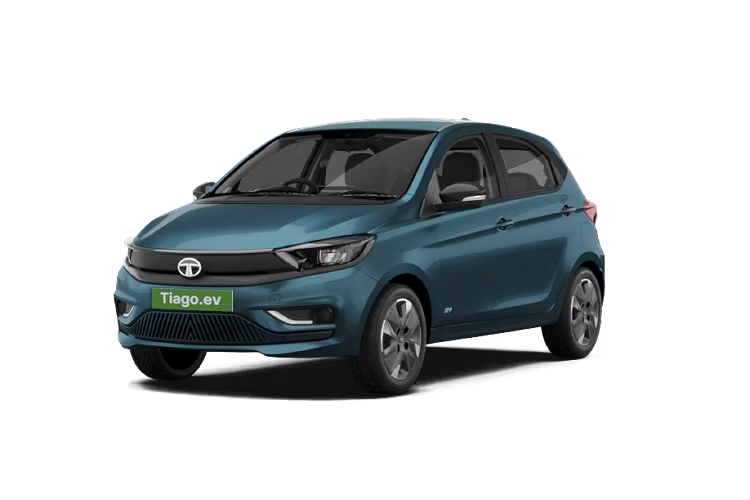
The idea of owning an electric car in India is no longer limited to premium buyers or early adopters. In recent years, manufacturers have started focusing on compact and affordable electric vehicles that make daily commuting cleaner and more economical. For buyers with a budget close to ₹10 lakh, the market is gradually opening up with options that promise lower running costs, simple maintenance and city-friendly practicality. These vehicles may not aim to deliver luxury or long highway ranges, but they are designed to serve urban users who want a dependable and efficient alternative to petrol hatchbacks.
Most affordable electric cars focus on simplicity and practicality. They are generally compact in size, easy to park in crowded cities and efficient in stop-and-go traffic conditions. Their electric motors provide instant torque, making them surprisingly quick at low speeds, while the silent driving experience adds a sense of refinement. For people who primarily use their cars for office commutes, grocery runs or short weekend drives, these EVs can reduce fuel expenses significantly over time while also contributing to lower emissions.
Visit the official Tata India website.
Another important factor behind the growing popularity of affordable EVs is the steady improvement in battery technology and charging infrastructure. While the driving range may not rival expensive electric SUVs, most entry-level EVs can comfortably cover daily city distances without frequent charging. Combined with government incentives and lower maintenance requirements, electric cars under ₹10 lakh are slowly becoming a practical option for first-time car buyers as well as those looking for a secondary city vehicle.
Tata Tiago EV
- Approximate Price Range: Around ₹8.5 lakh to ₹11 lakh depending on variant, making the base versions close to the ₹10 lakh bracket.
- Battery Options: Offered with two battery packs that allow buyers to choose between affordability and longer range.
- Claimed Driving Range: Approximately 250 km to over 300 km depending on the battery option and driving conditions.
- Motor Performance: The electric motor delivers smooth and instant acceleration, making it very responsive in city traffic.
- Charging Options: Supports both standard home charging and faster charging solutions for quicker top-ups.
- Interior and Comfort: The cabin feels modern with a digital instrument cluster, touchscreen infotainment system and connected features.
- Safety Equipment: Dual airbags, ABS with EBD and stability control help maintain basic safety standards.
- Practicality: A usable boot space and comfortable seating make it suitable for small families.
- Driving Experience: Light steering and compact dimensions make it easy to drive through narrow streets and crowded parking areas.
- Overall Appeal: One of the most balanced affordable EVs with a good mix of range, features and everyday usability.
MG Comet EV
- Approximate Price Range: Starts close to ₹7 lakh and goes up depending on features, keeping it well within the affordable EV category.
- Battery Pack: Uses a compact battery designed primarily for urban driving needs.
- Claimed Driving Range: Around 200 to 230 km on a full charge in ideal conditions.
- Motor Performance: Built for efficiency rather than speed, offering smooth acceleration for city use.
- Charging: Designed mainly for home charging with a standard socket, making it convenient for daily charging overnight.
- Design and Dimensions: Extremely compact and futuristic styling with a very small footprint, ideal for dense urban areas.
- Interior Technology: Dual digital screens for infotainment and instrument display give the cabin a modern feel despite the small size.
- Seating Layout: Primarily suited for two adults in front with occasional rear passenger use due to limited space.
- Ease of Driving: The tiny turning radius and small size make it one of the easiest cars to maneuver in traffic.
- Overall Appeal: Best suited for buyers who want a stylish, tech-focused electric city car mainly for short daily commutes.
Tata Nano EV (Expected)
- Expected Price Range: Industry expectations suggest a price around ₹6 lakh to ₹9 lakh if launched.
- Battery and Range: Likely to offer a small but efficient battery capable of delivering around 200 km of range.
- Motor Performance: Expected to prioritize efficiency and ease of driving rather than performance.
- Charging Setup: Basic home charging capability will likely remain the primary charging method.
- Design Philosophy: A compact and lightweight design aimed at urban practicality and low ownership costs.
- Interior Simplicity: Expected to focus on essential features rather than luxury, keeping the price accessible.
- Target Buyers: Ideal for first-time car buyers or people upgrading from two-wheelers to a small four-wheeler.
- Running Costs: Electric powertrain could make it one of the cheapest cars to run on a daily basis.
- City Friendliness: Small size and light controls would make it easy to drive in congested city environments.
- Overall Appeal: If introduced, it could become one of the most affordable electric cars available in India.
PMV EaS-E (Ultra-Compact EV)
- Approximate Price Range: Positioned around ₹5 lakh to ₹8 lakh depending on the configuration.
- Battery Variants: Multiple battery options designed to offer different driving ranges.
- Claimed Range: Approximately 120 km to 200 km depending on the battery choice.
- Vehicle Size: Much smaller than traditional hatchbacks, designed as a micro-electric mobility solution.
- Seating Configuration: Unique seating layout with a central driving position and compact passenger space.
- Charging: Standard home charging capability suitable for overnight charging.
- Technology: Includes digital displays and connected features despite its compact form.
- Urban Mobility Focus: Specifically designed for crowded cities where parking and maneuverability are major challenges.
- Efficiency: Lightweight construction helps improve battery efficiency and reduce running costs.
- Overall Appeal: A niche electric mobility option that focuses purely on affordability and city commuting.
Overview:
In conclusion, the affordable EV segment in India is gradually evolving as manufacturers experiment with compact platforms, efficient batteries and city-friendly designs. While options under ₹10 lakh are still limited compared to petrol hatchbacks, the available models already demonstrate how electric mobility can fit into everyday life without requiring a massive budget. For buyers who mainly drive within the city and want to reduce fuel expenses, these electric cars represent a practical step toward cleaner and more economical transportation.
Stay tuned and follow up for more.