
Here is all the essential info on the Hyundai Venue’s NCAP testing.
Also read about the OLA S1x vs it’s competition.
Hyundai Venue Safety Rating:
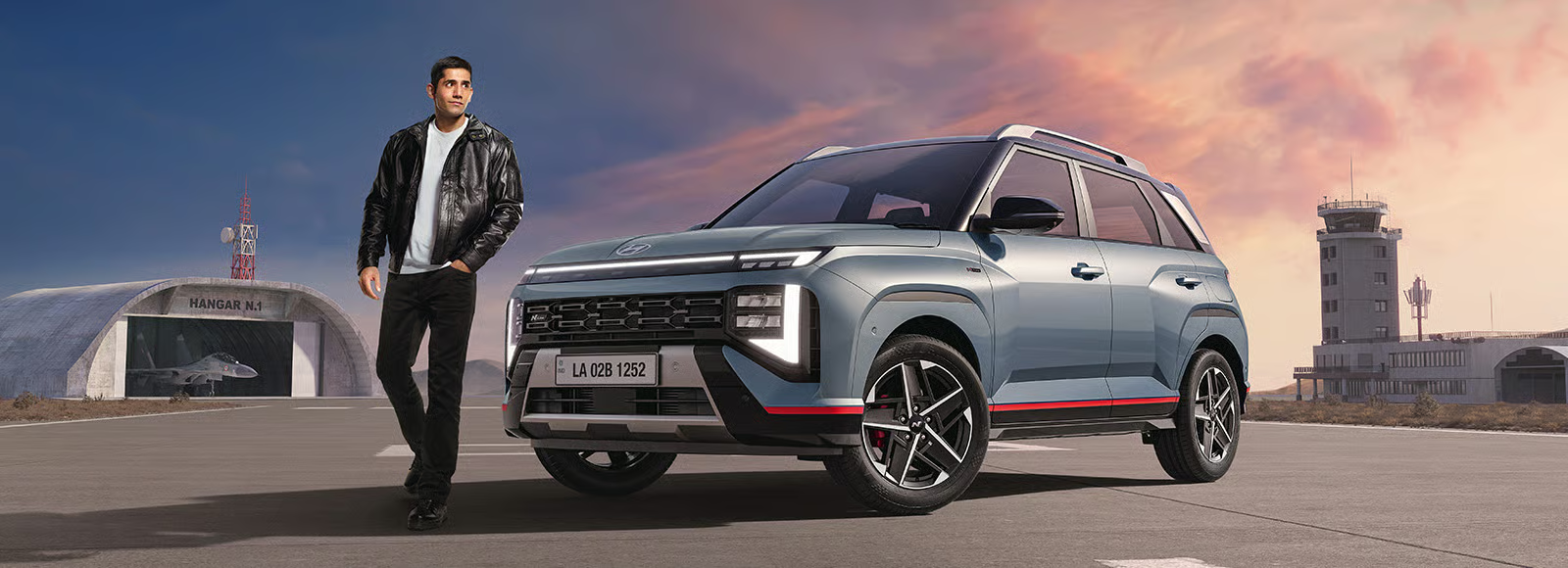
The recently updated Hyundai Venue has stepped into its new generation with a strong focus on safety, and its latest performance in the Bharat NCAP crash tests reflects that commitment in a compelling way. Scoring an impressive 31.15 out of 32 in Adult Occupant Protection and 44.46 out of 49 in Child Occupant Protection, the compact SUV positions itself confidently among the safest offerings in the highly competitive sub-four-metre SUV category. The results are not just numbers but an indication of how far the segment has evolved, where structural integrity, restraint systems and occupant safety are no longer optional extras but essential benchmarks. In the frontal offset deformable barrier test, the Venue demonstrated excellent energy absorption and structural stability with a score of 15.15 out of 16, while the side movable deformable barrier test yielded a perfect 16 out of 16, highlighting its strong side-impact resilience. Even the side pole impact test, often considered more demanding, returned an acceptable rating, further reinforcing the SUV’s well-rounded safety engineering. These results showcase Hyundai’s ability to blend design, engineering and safety into a cohesive package that caters to modern buyers who are increasingly conscious about protection without compromising on practicality or style.
What further strengthens the appeal of the Venue is its performance in child occupant protection, an area that is often overlooked in entry-level SUVs. The SUV scored 23.46 out of 24 in dynamic crash testing with child restraint systems and a full 12 out of 12 in CRS installation assessment, underlining its compatibility with child safety equipment. Although it scored 9 out of 13 in the vehicle assessment category, the cumulative result of 44.46 out of 49 still stands as a strong achievement. Standard safety equipment in the Venue includes dual front airbags, side curtain airbags, side chest airbags, electronic stability control, pedestrian protection measures and seat belt reminders across all variants, making it a well-equipped package right from the base trims. However, there are still a few areas where improvement could elevate the overall offering further, such as the absence of knee airbags and side pelvis airbags. Additionally, ISOFIX mounts are limited to the second-row outboard seats and there is no integrated child restraint system, although Hyundai has included a manual airbag cut-off switch to provide flexibility when installing child seats in the front. The tested models included diesel variants with both manual and automatic gearboxes, weighing around 1,610 kg, and the safety rating extends across multiple petrol and diesel configurations, ensuring consistency across the lineup.
Visit the official Hyundai India website.
When compared to its key rivals, the Hyundai Venue holds its ground impressively while also revealing subtle distinctions that buyers may want to consider. In this segment, competitors like the Tata Nexon, Mahindra XUV300, Maruti Suzuki Brezza and Kia Sonet each bring their own strengths to the table.
- The Tata Nexon has long been regarded as a benchmark for safety in the segment, with consistently high crash test scores and a reputation for robust build quality, often appealing to buyers who prioritise maximum protection above all else.
- The Mahindra XUV300 also stands out with its strong safety credentials and comprehensive airbag suite, offering a slightly more rugged perception in terms of structural strength and occupant security.
- The Maruti Suzuki Brezza, while not always leading in crash scores historically, has significantly improved in recent iterations and balances safety with reliability, fuel efficiency and widespread service support.
- The Kia Sonet, sharing its platform with the Venue, offers a similar safety architecture but differentiates itself with a more feature-rich cabin and a slightly sportier appeal, although safety perception often mirrors that of its Hyundai sibling.
Against this backdrop, the Hyundai Venue emerges as a well-balanced contender that blends strong crash test performance with a rich list of standard safety features and everyday usability. It may not dramatically outshine every rival in every parameter, but it delivers a cohesive package that appeals to a wide audience looking for value for money, modern design and dependable safety. The near-perfect adult occupant score and impressive child protection results ensure that it stands shoulder to shoulder with the best in the segment, while its minor shortcomings remain areas for future refinement rather than deal-breakers. In essence, the new-generation Venue reflects how the compact SUV space in India is maturing rapidly, where safety is becoming a defining factor rather than a secondary consideration, and in that evolution, Hyundai has ensured that its offering remains both competitive and reassuringly secure.
Stay tuned and follow up for more.