
Tata Sierra Diesel 2026
A Comeback Built on More Than Nostalgia
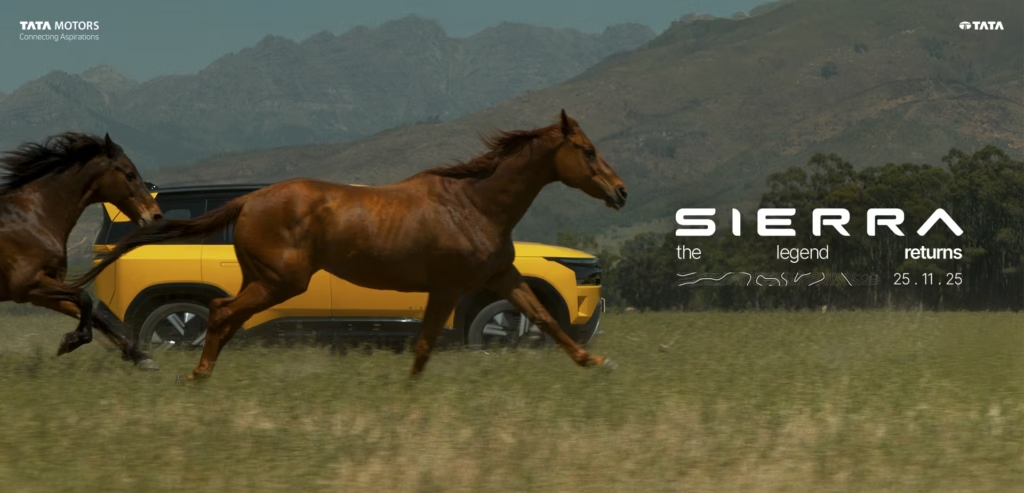
Most revival stories in the Indian auto industry play on emotion and deliver disappointment. The Tata Sierra is an exception, and that is not brand loyalty talking.
Tata Motors did not just slap a familiar name on a new body. The Sierra returns as a fully engineered midsize SUV sitting between the Curvv and the Harrier in Tata’s portfolio, a deliberate positioning move that targets buyers who want something more purposeful than a Curvv but do not need the sheer size of the Harrier.
Priced between ₹11.49 lakh and ₹21.29 lakh (ex-showroom), it enters one of the most crowded and competitive SUV segments in the country. The Tata Sierra Diesel 2026, specifically, is what most of the market is gravitating toward. This article is for buyers who want to know whether that instinct is well-founded.
Also read about TVS’ March 2026 sales in India.
Price & Variants Diesel Lineup
The diesel engine is not available on the base Smart+ trim. It enters from the Pure variant upward, giving buyers a reasonable spread across six trims.
Diesel variant pricing (ex-showroom):
- Pure Diesel MT: ₹12.99 lakh
- Pure+ Diesel MT: ₹14.49 lakh (approx.)
- Adventure Diesel MT: ₹15.29 lakh
- Adventure+ Diesel MT: ₹16.49 lakh (approx.)
- Adventure+ Diesel AT 1: ₹17.49 lakh (approx.)
- Accomplished Diesel AT: ₹19.49 lakh (approx.)
- Accomplished+ Diesel AT: ₹21.29 lakh
On-road, expect the base diesel to cross ₹15.5 lakh once you factor in RTO and insurance. Against the Creta diesel and Seltos diesel, the Sierra holds its ground on price, and in several trims, it pulls ahead on feature value.
One note: Tata Motors revised ICE vehicle prices by a modest 0.5% from April 2026. The figures above reflect post-revision levels.
Key Highlights
- 1.5L Kryojet CRAIL diesel, 118 PS, 260 Nm (MT) / 280 Nm (AT)
- No AdBlue (DEF) requirement, lower long-term running costs
- 5-star Bharat NCAP rating for both adult and child occupant protection
- Level 2 ADAS on higher trims, adaptive cruise, emergency braking, lane assistance
- 6 airbags across all variants as standard equipment
- Over 1 lakh bookings since launch; current waiting period approximately 6–7 months
Engine & Performance: What the Numbers Actually Mean
The diesel motor displaces 1,497cc in a four-cylinder configuration. Peak power of 118 PS arrives at 4,000 rpm, while torque, 260 Nm on the manual, 280 Nm on the automatic builds from as low as 1,500 rpm. That low-end torque character matters a great deal in stop-start city traffic and on climbing roads.
In highway conditions, the engine settles into a quiet, relaxed cruise without demanding frequent downshifts. The automatic transmission pairs well with this character, it is the smarter choice for anyone logging significant city kilometers.
Fuel efficiency in real-world conditions averages roughly 13 kpl in city use and around 14.5 kpl on the highway for the automatic variant. The ARAI-certified figure of approximately 19–21 kmpl reflects ideal test conditions and should not be used for ownership budgeting. The manual variant will return marginally better efficiency for disciplined drivers.
The diesel requires no AdBlue, a practical detail that removes one recurring maintenance step that some competing diesels demand.
Chassis, Dimensions & Safety
At 4,340 mm long, 1,841 mm wide, and 1,715 mm tall, the Sierra is a properly sized SUV with a 2,730 mm wheelbase. That wheelbase translates into usable rear passenger space — not cramped, not excessive. Ground clearance is rated at 205 mm, which puts it on par with other well-regarded SUVs in this segment.
The platform, Tata’s new ARGOS architecture, is designed with all-wheel drive capability in mind. AWD variants are under development and may follow in 2026, which is worth knowing if you plan to hold the car for several years.
The safety package is one of the Sierra’s clearest advantages. Standard across all variants: 6 airbags, ABS with EBD, electronic stability control, traction control, hill hold assist, electronic parking brake with auto hold, and front and rear parking sensors. Higher trims add a 360-degree camera and Level 2 ADAS, making the overall safety offering difficult to match at this price point.
The car also received a 5-star Bharat NCAP rating, the most credible safety benchmark available for Indian-market vehicles.
Design & Styling
The Sierra’s design is not trying to look like everything else in the segment. The raised bonnet line, angular wheel arches, pronounced B-pillar, and the characteristic kink in the window graphic all trace back to the original 1990s Sierra, reinterpreted rather than copied.
Up front, full-width LED lighting running across the hood gives it a road presence that most midsize SUVs in this price range cannot match. Flush door handles and 19-inch alloy wheels complete the exterior stance.
Six dual-tone colour options are on offer, Pristine White, Pure Grey, Bengal Rouge, Munnar Mist, Coorg Clouds, and Andaman Adventure, all with a contrasting black roof. The names lean heavily into an outdoorsy identity, and the colours themselves back that up.
The interior runs a beige-and-black dual-tone theme with brushed metal and piano black accents. Higher variants get a triple-screen layout, a 12.3-inch infotainment screen, 10.25-inch instrument cluster, and a third screen for climate controls, along with a panoramic sunroof, ventilated front seats, and a powered tailgate. The overall cabin feel is a step up from where Tata’s mass-market interiors used to sit.
Ownership & After-Sales
Tata Motors operates one of the more widespread service networks among Indian automakers — useful if you are buying in a Tier 2 or Tier 3 city where some Korean or European brands have thinner coverage.
The 5-star Bharat NCAP score also carries a practical ownership implication: better-rated vehicles typically attract lower insurance premiums over time.
The no-AdBlue diesel simplifies servicing. You deal with standard diesel maintenance: fuel filter, oil change, air filter: without the added cost and scheduling of DEF replenishment that some BS6 Phase 2 competitors require.
Accessories and customization options are available through Tata’s official ecosystem, though the lineup is still expanding given the Sierra’s relatively recent launch.
Competition
The Tata Sierra Diesel 2026 does not have a single defining rival. It competes across several:
- Hyundai Creta Diesel: the segment benchmark; strong resale, proven reliability, but design plays it safe
- Kia Seltos Diesel: premium cabin, sharp dynamics, competitive pricing on upper trims
- Honda Elevate: refined petrol options but no diesel; different buyer segment
- Maruti Grand Vitara: strong mild-hybrid credentials, but diesel is absent from its lineup
- Skoda Kushaq / VW Taigun: European ride quality and build, but feature-light for the money
- Renault Duster: the incoming wildcard; strong off-road credentials but not yet fully established in its current generation
The Sierra’s clearest edge over most of this list: it offers more standard safety kit, a more distinctive design, and a no-AdBlue diesel, all at a price that enters below the Creta and Seltos diesel midpoints.
Final Verdict, Is the Tata Sierra Diesel 2026 Worth Buying?
The short answer: yes, for the right buyer.
Diesel variants account for over half of all Sierra bookings, that ratio reflects genuine demand, not a manufactured trend. The engine delivers what a midsize SUV diesel should: low-end grunt, highway composure, and running costs that justify the premium over petrol at higher annual mileage.
The Adventure+ Diesel AT is the sweet spot in the lineup. It sits at a price where the feature set is generous without reaching the Accomplished+ territory, where you pay for items most buyers will rarely use.
The main concern is not the car itself, it is availability. A 6–7 month waiting period means you are making a decision today for a delivery that arrives well into the second half of 2026. If your current vehicle is still functional and you can absorb the wait, book now. If you need a car within the next two months, the Creta or Seltos diesel can be had faster without meaningful compromise.
For buyers who can wait and want something that does not look like every other SUV in the parking lot, backed by strong safety scores and a capable diesel engine, the Sierra makes a compelling case.
Q: What is the starting price of the Tata Sierra Diesel 2026?
The Tata Sierra Diesel 2026 starts at ₹12.99 lakh ex-showroom for the Pure MT variant. The top-spec Accomplished+ Diesel AT is priced at ₹21.29 lakh ex-showroom.
Q: What are the engine specs of the Sierra diesel?
The Sierra diesel runs a 1.5-litre four-cylinder turbocharged unit producing 118 PS at 4,000 rpm. Torque is rated at 260 Nm with the manual gearbox and 280 Nm with the automatic. Both 6-speed manual and 6-speed automatic transmission options are available.
Q: Does the Tata Sierra diesel need AdBlue?
No. The Sierra’s diesel engine does not require DEF or AdBlue, an advantage over some BS6 Phase 2 competitors that add this as a recurring cost and maintenance step.
Q: How does the Tata Sierra diesel compare to the Hyundai Creta diesel?
The Sierra starts slightly lower on diesel pricing, offers more standard safety equipment, and stands apart on design. The Creta counters with better resale value, a shorter waiting period, and a longer established track record. Buyers prioritising uniqueness, safety specs, and value per rupee will lean toward the Sierra; those prioritising resale and faster delivery will favour the Creta.
Published on TheWheelFeed.com | Specs and pricing based on manufacturer data and real-world test results as of April 2026.
