
Kia Seltos 2026 vs Tata Sierra
The Indian compact SUV segment has rarely seen two launches this significant arrive in the same window. The Kia Seltos 2026 arrived with a generational update, moving to Kia’s global K3 platform and growing substantially in size. Meanwhile, Tata Sierra made its long-awaited comeback, 22 years after the original was discontinued, riding an all-new ARGOS platform with a fresh identity and strong emotional pull.
Both are priced between ₹11–21 lakh (ex-showroom), both carry 1.5-litre engine families, and both target the same Indian buyer: urban, value-conscious, and unwilling to compromise on tech or safety. But they aren’t the same car. Understanding where they differ is what will determine which one belongs in your driveway.
This Kia Seltos 2026 vs Tata Sierra comparison cuts through the noise with specs, real-world context, and a clear verdict.
Also read about Renault Duster vs Hyundai Creta.
Price & Variants
Kia Seltos 2026 (Ex-Showroom)
- HTE: ₹10.99 lakh (entry-level, NA petrol)
- HTK: ₹12.59 lakh
- HTK (O): ₹13.39 lakh (first with panoramic sunroof)
- HTX / HTX+: ₹14.99–₹16.49 lakh
- GTX (Turbo): ₹16.99 lakh
- GTX+ / X-Line: up to ₹19.99 lakh (top-spec, diesel or turbo-petrol)
Tata Sierra (Ex-Showroom)
- Smart+: ₹11.49 lakh (base, NA petrol)
- Pure / Pure+: ₹12.99–₹14.49 lakh
- Adventure / Adventure+: ₹15.29–₹17.49 lakh
- Accomplished / Accomplished+: ₹19.49–₹21.29 lakh (diesel automatic at the top)
Positioning insight: The Seltos starts ₹50,000 cheaper but the Sierra tops out ₹1.30 lakh higher. At equivalent trim levels, pricing is broadly competitive. The Seltos has the wider variant spread; the Sierra’s Accomplished+ diesel-AT is the most expensive ICE car in this segment from either brand.
Key Highlights
Kia Seltos 2026
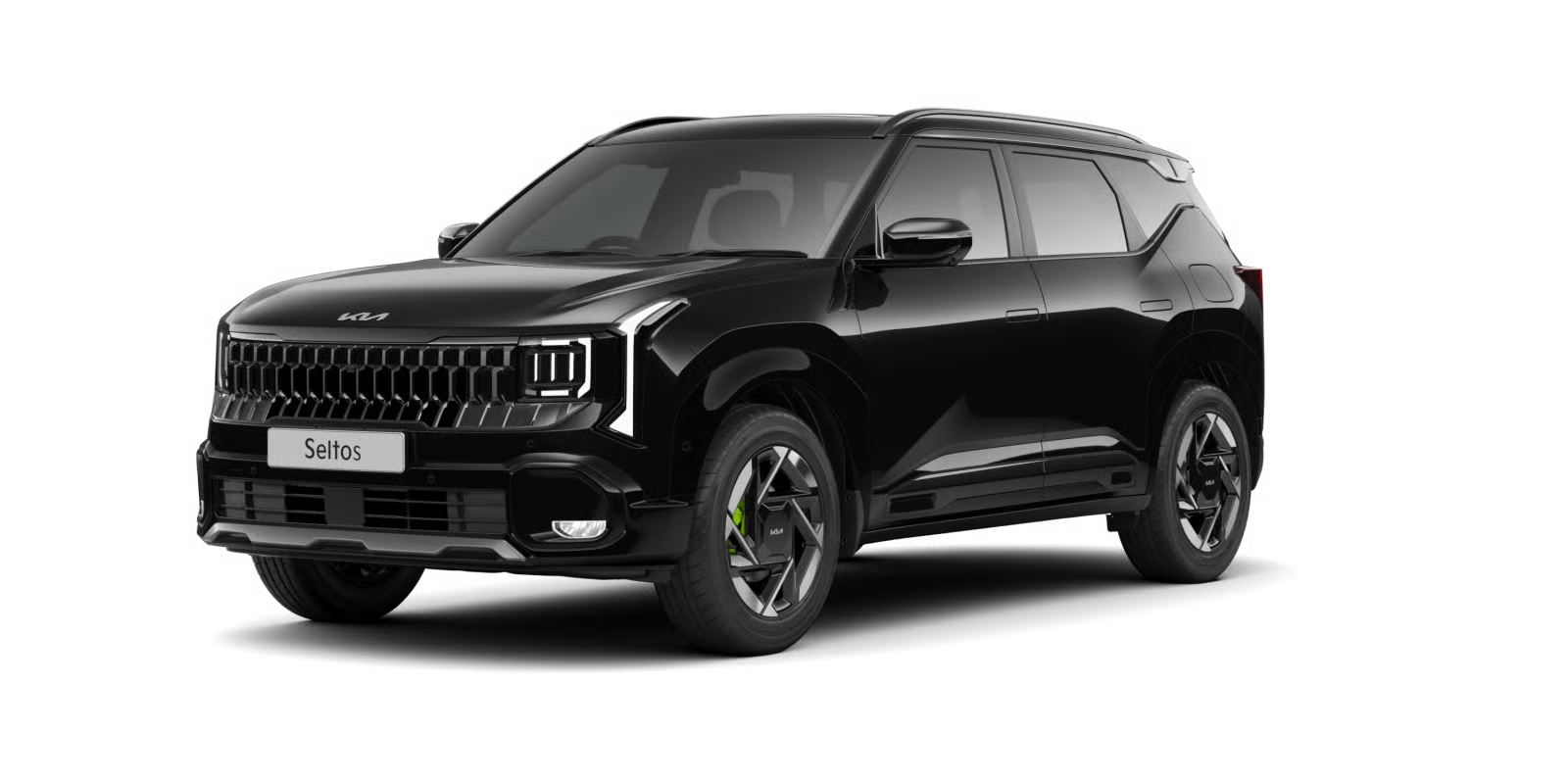
- Built on the K3 platform, now 95mm longer than predecessor (4,460mm total)
- Triple-engine lineup: NA petrol, 1.5T-GDi turbo-petrol, 1.5 CRDi diesel
- ADAS Level 2+ with 21 autonomous safety functions
- Trinity Panoramic Display: dual 12.3-inch screens in one seamless unit
- 5-star Bharat NCAP safety rating; 6 airbags standard across all variants
- Dual-pane panoramic sunroof, Bose 8-speaker system, flush door handles
Tata Sierra
- All-new ARGOS platform; India’s first ICE car with 5G connectivity
- Three engines: 1.5L NA petrol, 1.5L DI turbo-petrol, 1.5L diesel
- Longest wheelbase in class: 2,730mm (80mm more than Seltos)
- Segment-first triple-screen setup including a dedicated co-driver screen
- 19-inch alloy wheels on top variants, largest in the segment
- 70,000+ bookings on Day 1 of order opening, significant market signal
Engine & Performance
Kia Seltos 2026
Three engines, five gearbox options, the Seltos offers genuine powertrain flexibility.
The base 1.5L NA petrol (115 PS / 144 Nm) paired with a 6MT or CVT is tuned for effortless urban commuting. Smooth, predictable, and fuel-efficient at 17–18 kmpl (ARAI). The CVT option is particularly well-suited for city buyers who prioritize ease over engagement.
Step up to the 1.5L T-GDi turbo-petrol (160 PS / 253 Nm) with 6iMT or 7DCT, and the character shifts entirely. This engine pulls cleanly from low revs, dispatches highway overtakes without drama, and hits 100 km/h in under 9 seconds. The 7DCT is fast and smart, one of the better dual-clutch units at this price point.
The 1.5L CRDi diesel (116 PS / 250 Nm) remains the long-distance traveller’s pick. The 6AT option makes it genuinely comfortable on National Highway runs, returning close to real-world 18+ kmpl on open roads.
Tata Sierra
Sierra’s base 1.5L NA petrol (106 PS / 145 Nm) is less potent than the Seltos equivalent, though Tata pairs it with both a 6MT and a 7DCT, a stronger gearbox choice than the Seltos’s CVT if you’re prioritizing response over smoothness.
The highlight is the all-new 1.5L DI turbo-petrol (160 HP / 255 Nm), Tata’s first direct-injection petrol engine. It’s available exclusively with a 6-speed torque converter AT, which is smoother than the Seltos’s DCT but slightly less snappy in kick-down response. Real-world 0–100 km/h in approximately 10.2 seconds, marginally behind the Seltos turbo.
The 1.5L turbo-diesel (118 HP, 280 Nm with AT) is the most torque-rich engine in this comparison and a clear long-highway winner. Diesel variant bookings reportedly represent 55% of Sierra orders in India, a clear signal of buyer intent.
Edge: Seltos on powertrain breadth and DCT performance. Sierra on diesel torque and turbo-petrol refinement.
Chassis, Wheels & Features
| Spec | Kia Seltos 2026 | Tata Sierra |
|---|---|---|
| Length | 4,460 mm | 4,340 mm |
| Wheelbase | 2,690 mm | 2,730 mm |
| Width | 1,830 mm | 1,841 mm |
| Ground Clearance | 200 mm | 205 mm |
| Boot Space | 447 litres | 450 litres |
| Wheels | 16–18 inch | 17–19 inch |
The Sierra’s 2,730mm wheelbase is the longest in the segment, the rear cabin benefits measurably, especially for three-abreast seating. The Seltos is longer overall but the Sierra feels more planted and commanding on rough surfaces, partly due to its higher-profile 19-inch alloy fitment on top variants.
Both carry front and rear disc brakes, ABS with EBD, traction control, ESC, TPMS, and 360-degree cameras on higher trims. Ground clearance is near-identical and sufficient for Indian road conditions.
The Sierra adds frequency-dependent damping (FDD) on Adventure and above variants, a meaningful real-world upgrade for potholed urban roads and broken highway stretches.
Design & Styling
The Kia Seltos 2026 draws design DNA from the EV9 flagship. The bold rectangular grille, vertical DRLs that sweep onto the bonnet, flush door handles, and Star Map LED tail lamps give it an unmistakably modern crossover silhouette. The X-Line variant adds matte graphite paint and neon brake calipers, a GTI-style visual trick that works well at this price.
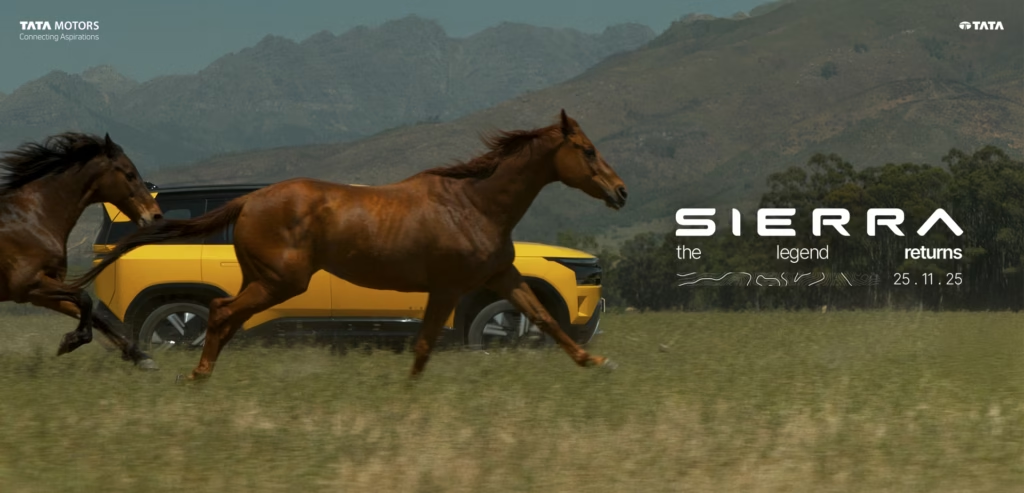
The Tata Sierra’s design is a different kind of statement. The high-set bonnet, squared wheel arches, thick B-pillar, and kink in the window line pay deliberate homage to the original 1991 Sierra. It’s boxy, it’s tall, and on the road, it turns heads without trying. Colours like Munnar Mist and Bengal Rouge are India-exclusive and give the Sierra a character the Seltos’s palette doesn’t match.
Edge: Sierra on visual presence and distinctiveness. Seltos on design modernity and segment polish.
Ownership & After-Sales
Kia Seltos 2026: Kia offers a standard 3-year / unlimited km warranty, extendable to 5 years. The brand has built a dense dealer and service network across India since 2019, over 600 touchpoints — which is a practical advantage for tier-2 and tier-3 city buyers. Parts availability and service costs are well-documented and predictable.
Tata Sierra: Tata offers a standard 3-year / 1,00,000 km warranty. Tata’s dealer network is one of the widest in India, 1,500+ service centres, and is particularly strong in smaller towns where Korean brands have thinner presence. The Sierra also gets OTA updates for up to 10 ECUs, a genuinely future-proof advantage for software-driven features.
Edge: Tata on service reach and software longevity. Seltos on established ownership experience and parts predictability.
Competition
In the Kia Seltos 2026 vs Tata Sierra fight, both cars face the same competitive set:
- Hyundai Creta: The segment leader; shares underpinnings with the Seltos but different character
- Maruti Suzuki Victoris: 2025 ICOTY winner; strong hybrid option in this price band
- Maruti Grand Vitara / Toyota Hyryder: Hybrid-first alternatives for buyers prioritising efficiency over features
- Honda Elevate: Refinement-focused, conservative design, a solid Seltos alternative
- Volkswagen Taigun / Skoda Kushaq: Better driving dynamics; narrower feature set
Neither the Seltos nor the Sierra is under serious threat from the Taigun or Kushaq on volume grounds. The real battle is between the Sierra, Creta, and the Victoris for segment dominance, the Seltos sits in the middle of this triangle.
Final Verdict
Buy the Kia Seltos 2026 if: You want a feature-rich, proven compact SUV with the widest powertrain options, strong safety credentials, and a dealer network that won’t let you down anywhere in India. The turbo-petrol DCT combination is the best in class for those who value performance and urban usability together.
Buy the Tata Sierra if: You want the longest wheelbase in this segment, a genuinely distinctive design, and the most future-ready cabin technology, including 5G connectivity, a dedicated co-driver screen, and OTA updates. The diesel variants are compelling for high-mileage users, and the emotional pull of the Sierra nameplate is real.
The honest view: The Kia Seltos 2026 vs Tata Sierra is less about which car is objectively better and more about what kind of buyer you are. The Seltos is the safer, more rounded choice with a proven track record. The Sierra is bolder, more distinctive, and more ambitious, it’s for the buyer who wants to own something that doesn’t just blend into traffic.
Neither is a wrong choice. Both are better than most of what this segment has offered before.
Q1. What is the price of the Kia Seltos 2026 vs Tata Sierra in India?
The Kia Seltos 2026 is priced from ₹10.99 lakh to ₹19.99 lakh (ex-showroom). The Tata Sierra starts at ₹11.49 lakh and goes up to ₹21.29 lakh (ex-showroom).
Q2. Which has a better engine — Kia Seltos 2026 or Tata Sierra?
The Seltos offers three engine options (NA petrol, turbo-petrol, diesel) across five gearbox combinations. The Sierra also offers three engines but the turbo-petrol is limited to one gearbox (6AT). The Seltos turbo-petrol DCT has a performance edge; the Sierra diesel-AT wins on torque (280 Nm vs 250 Nm).
Q3. Is the Tata Sierra bigger than the Kia Seltos 2026?
The Seltos is longer overall (4,460mm vs 4,340mm), but the Sierra has a larger wheelbase (2,730mm vs 2,690mm) and greater height (1,715mm vs 1,620mm), giving it a more commanding road presence and more rear headroom.
Q4. Which is safer — Kia Seltos 2026 or Tata Sierra?
Both have received 5-star ratings under Bharat NCAP and offer 6 airbags as standard along with ADAS Level 2. The Seltos has ADAS Level 2+, which includes a slightly wider suite of autonomous safety features across more variants.
Stay tuned and follow up for more.
