
Tata Sierra EV 2026
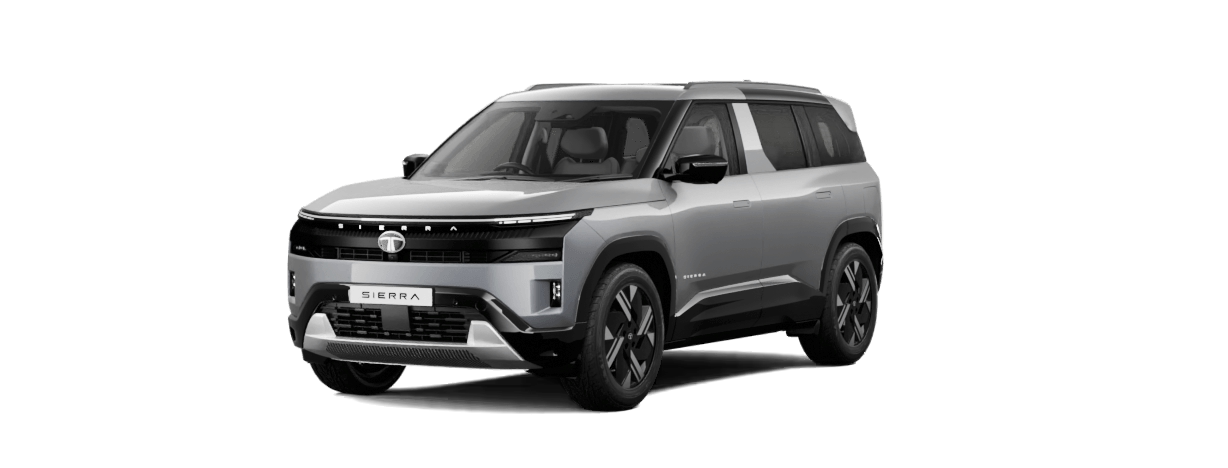
The Tata Sierra is back. After three decades, one of India’s most culturally significant vehicles has returned as an all-electric SUV, and if you’ve been following the Tata Sierra EV 2026 buzz, you already know that this launch is about more than just another electric car. It’s about whether Tata Motors can turn an emotional memory into a rational purchase decision in 2026.
Also read about the Strong Hybrid Cars in India.
What Exactly Is the Tata Sierra EV, and Why Does It Matter?
The original Sierra, produced from 1991 to 2000, was one of the first genuine Indian-made SUVs, boxy, distinctive, and instantly recognisable thanks to its signature wrap-around glass panel on the C-pillar. Tata axed it as the market evolved, but the Sierra never really left the Indian consciousness. When Tata teased its revival at Auto Expo 2020, the internet collectively lost its mind.
Fast forward to May 2026, and the Sierra is back as a fully electric SUV priced between ₹11.49 lakh and ₹21.29 lakh (ex-showroom). That’s a wide range spanning multiple variants, which means Tata is genuinely trying to make this accessible, not just a collector’s nostalgia piece for enthusiasts with deep pockets.
Specs and Range: What Are You Actually Getting?
The Tata Sierra EV sits on Tata’s Gen 2 electric architecture, the same platform underpinning the Nexon EV and Punch EV. This is both reassuring and slightly limiting, reassuring because it’s a proven, reliable base, and limiting because you’re not getting some radical next-gen EV tech.
Battery and range details are still being confirmed ahead of the May 19 launch, but early indications suggest a mid-size battery pack in the 45–60 kWh range, targeting a claimed range of around 400–450 km on a full charge. The cabin carries forward the retro design language, that iconic glass panel is back, combined with a modern dual-screen setup, ventilated front seats, and Level 2 ADAS as expected on a 2026 launch.
Tata’s EV portfolio in India has grown impressively: Tata Motors sold 8,543 units in April 2026 alone, a 77% jump year-on-year, making it the undisputed leader in the Indian EV market with over 36% market share. The Sierra is meant to add a premium, emotionally resonant product to that already strong lineup.
The Nostalgia Factor: Asset or Liability?
Here’s where things get interesting. Tata is betting heavily on nostalgia as a sales lever, and it might work, at least initially. People who grew up seeing the original Sierra parked outside Himalayan resorts or in their father’s driveway will absolutely feel a pull toward this car. That emotional connection is real.
But nostalgia doesn’t age well in the showroom. Once the Diwali rush settles, real buyers will ask hard questions: How does the 450 km claimed range translate to actual highway driving? How does it compare with the Mahindra BE 6 in terms of ride quality? What is the real-world cost of ownership over five years?
The Sierra EV’s ₹21.29 lakh top variant is competing directly with the Maruti e Vitara’s fully-loaded Alpha trim at ₹20.01 lakh and the upcoming Toyota Urban Cruiser Ebella. At that price, buyers have genuine alternatives with newer tech and stronger charging ecosystems. Tata’s advantage is the Sierra badge, but that only takes you so far.
Who Should Actually Buy the Tata Sierra EV?
Consider this scenario: You’re a 38-year-old professional in Pune, working in IT, and your childhood home had an original white Sierra parked outside. You’re in the market for an electric SUV between ₹14 and ₹18 lakh, you want something different from the standard Nexon EV you see on every street, and you want your car to say something. For you, the Sierra EV is the obvious choice.
But if you’re a first-time EV buyer in a Tier-2 city like Nashik or Coimbatore, focused entirely on range, charging infrastructure, and long-term cost savings, you might be better served by the more proven Nexon EV or the new Maruti e Vitara, which comes with Maruti’s unmatched dealer and service network.
The Sierra EV is a lifestyle product with a functional EV underneath it. That’s not a criticism, it’s just clarity on what you’re buying.
What This Means for Indian Buyers
Tata continues to set the pace in India’s EV race, and the Sierra EV proves the brand isn’t just fighting on specs, it’s fighting on story. The ability to revive an iconic Indian nameplate as an all-electric SUV is genuinely impressive, and if the pricing holds competitive at launch, the Sierra EV could become one of the more interesting stories in the Indian auto industry this year.
For buyers in the ₹12–18 lakh range, this deserves serious consideration, but don’t let nostalgia make the final call. Take a test drive, check the real-world range, and compare it honestly with the Maruti e Vitara before signing anything.
Final Verdict / Our Take
The Tata Sierra EV 2026 is a smart product with a powerful story. Tata has successfully channeled decades of emotional goodwill into a modern EV that should attract both first-time EV buyers and returning Sierra fans. The wide ₹11.49–21.29 lakh price range ensures nobody is priced out, and at the entry-level variants, the value-for-money case is genuinely strong.
Our concern is the mid-to-top variants, where the Sierra faces stiffer competition and where nostalgia alone won’t close the deal. If Tata delivers on real-world range and service support, this could be one of the launches of the year. We’ll be watching the May 19 numbers closely.
Frequently Asked Questions (FAQs)
Q1. What is the price of the Tata Sierra EV 2026 in India?
The Tata Sierra EV 2026 is priced between ₹11.49 lakh and ₹21.29 lakh (ex-showroom), making it one of the more accessibly priced options in the compact electric SUV segment. Prices vary across multiple variants, from a base trim to a fully-loaded top-spec version.
Q2. What is the expected range of the Tata Sierra EV on a full charge?
While official ARAI figures are yet to be confirmed at launch, early indications suggest a claimed range of around 400–450 km for the larger battery variant. Real-world range in mixed city and highway driving typically comes in 15–20% lower than the claimed figure.
Q3. How does the Tata Sierra EV compare with the Tata Nexon EV?
The Sierra EV is positioned above the Nexon EV, with a larger, more SUV-forward design and premium styling cues including the revived C-pillar glass panel. However, the Nexon EV benefits from a longer track record, lower starting price, and Tata’s most refined EV service infrastructure to date.
Q4. Should I wait for the Tata Sierra EV or buy a Maruti e Vitara now?
If the retro-electric design and Sierra legacy matter to you, waiting for the May 19 launch makes complete sense — especially for the mid-range variants. However, if Maruti’s service network and BaaS pricing flexibility are priorities, the e Vitara is already on sale and well-reviewed.
— Manav Akbari, TheWheelFeed
