
Tata Punch Sales
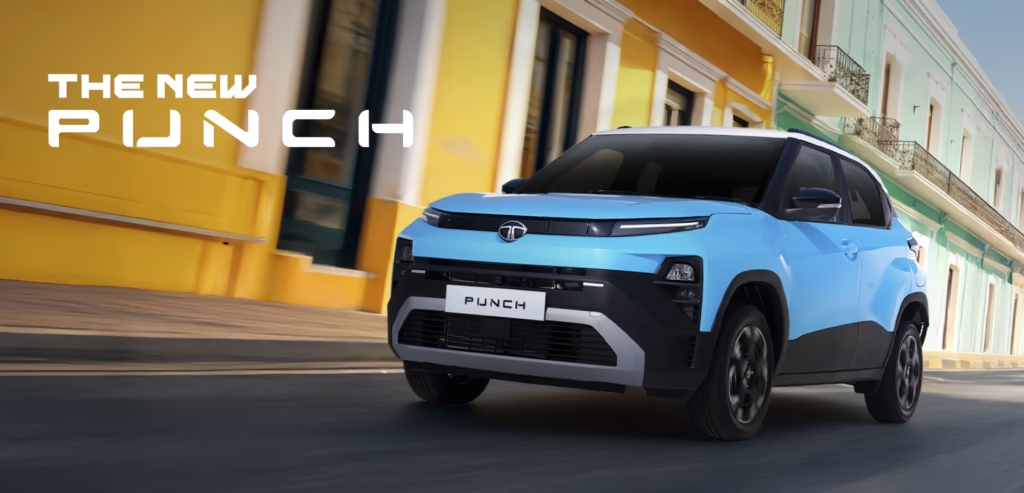
Ask anyone to name India’s best micro SUV right now, and you’ll almost always hear the same answer: Tata Punch. In April 2026, the Punch sold 19,107 units, a 53% year-on-year jump, making it the bestselling SUV in India for the month. It’s crossed 6 lakh cumulative sales in under four years, earning the title of India’s fastest-selling SUV. But raw sales numbers don’t tell you whether the Tata Punch best SUV to buy India 2026 story is actually true, or just a reflection of aggressive pricing and smart marketing.
Here’s what’s genuinely driving those 19,000 monthly sales, and the honest verdict on whether the Punch deserves to be on your shortlist.
Also read about Nissan Tekton vs Hyundai Creta.
Reason 1: It Has 5-Star Safety Ratings — At Sub-7 Lakh Pricing
Start with the thing that matters most and is discussed the least: safety. The Tata Punch holds a 5-star Global NCAP rating for both adult and child occupant protection. The Punch EV holds both 5-star GNCAP and 5-star Bharat NCAP ratings. In a price band, Rs 6.29 to 12.37 lakh, where many rivals still offer 0- or 1-star NCAP ratings, this is a structural competitive advantage.
This matters particularly for first-time car buyers, who make up an estimated 69% of Punch customers according to Tata Motors’ own data. First-time buyers are often young families stepping out of a two-wheeler or older hatchback. The safety conversation, increasingly mainstream after Bharat NCAP testing became public, now directly translates to purchase decisions. When a family in Jaipur or Coimbatore is choosing between a sub-7 lakh hatchback with no NCAP rating and a Punch at Rs 6.29 lakh with 5 stars, the choice becomes almost obvious.
The Punch’s structural safety is real, not just a test-day performance. The platform, the build quality, and the consistent owner feedback on accident responses all validate the rating. Safety alone cannot explain 19,000 monthly sales, but it explains why 69% of first-time buyers feel comfortable spending Rs 7–9 lakh on a Tata product.
Reason 2: The Powertrain Range Is Unmatched in Its Price Band
No other micro SUV in India offers the breadth of powertrain options the Punch does. Choose from:
- 1.2-litre naturally aspirated petrol (manual and AMT)
- 1.2-litre turbo petrol (manual and AMT), added in the 2026 facelift
- CNG (shared twin-cylinder kit with the Altroz)
- Electric (Punch EV, with two battery variants)
A buyer looking for the lowest running cost gets the CNG. A city professional who wants convenience chooses the NA petrol AMT. An enthusiast who wants performance from a micro SUV gets the turbo petrol. An EV-curious buyer who doesn’t want a premium-priced EV gets the Punch EV from approximately Rs 10 lakh. All under one badge.
This breadth is Tata’s masterstroke and rivals cannot easily replicate it. The Maruti Fronx, the Punch’s closest sales rival, offers petrol and mild hybrid options only. The Hyundai Venue has petrol, diesel, and CNG but no EV. The Punch covers every buyer’s running cost preference, which means it wins consideration rounds that other cars don’t even enter.
Reason 3: The SUV Stance at Hatchback Pricing
Let’s be practical about what most Indian buyers actually want. They want to sit high. They want ground clearance for speed breakers, flooded roads, and the occasional unmade road to a relative’s house. They want something that looks like an SUV in the colony parking lot, not something they need to apologize for in front of friends who bought Venues and Sonet.
The Punch delivers exactly this. At approximately 187mm of ground clearance, a 4.5-metre turning radius that makes Mumbai traffic manageable, and an upright silhouette that reads as SUV from any angle, the Punch gives buyers the visual and practical confidence of an SUV at hatchback pricing. Starting at Rs 6.29 lakh, it undercuts the Maruti Fronx (from Rs 6.85 lakh) and the Hyundai Venue (from Rs 8.38 lakh) meaningfully.
For Tier 2 and Tier 3 buyers, a segment where the Punch does enormous volumes, this combination of elevated ride height, compact footprint (3,827mm length), and aggressive starting price is essentially the perfect product spec.
Reason 4: The 2026 Facelift Addressed the Main Complaint
The pre-facelift Punch had one consistent criticism from buyers and reviewers: the 1.2-litre NA petrol felt underpowered on highways. 88 hp was perfectly adequate for city driving but left buyers wanting more on expressways. The 2026 Punch facelift, launched in early 2026, addressed this with a new 1.2-litre turbo petrol option producing 120 hp and 170 Nm.
That’s not a minor upgrade. It fundamentally changes the Punch’s highway character. The turbo petrol variant makes the Punch a genuinely capable daily driver for mixed city-highway use, something the old Punch struggled to be convincingly. The 53% year-on-year growth in April 2026 is partly a direct reflection of facelift demand. Buyers who were on the fence about the NA Punch now have a reason to move.
Additionally, the facelift brought revised front styling, new colour options, and feature additions at equivalent price points, compressing the value gap between base and mid variants.
Reason 5: Tata’s EV Halo Effect
Tata’s EV credibility in India, built on the Nexon EV’s five-year success and the Punch EV’s strong reception, directly benefits the ICE Punch brand. When a buyer considers a Tata product in 2026, they’re not seeing a traditional automaker. They’re seeing the company with India’s largest EV ownership base and a proven commitment to electric mobility.
This brand halo makes fence-sitters more comfortable with the ICE Punch too. Tata’s focus on safety, modern platforms, and electric technology signals a company investing in the future, which psychologically reduces concerns about long-term support and after-sales reliability. Tata EV sales also jumped 77% year-on-year in April 2026, further reinforcing the brand’s momentum.
But Should YOU Buy One?
Here’s the honest part.
Buy the Punch if: You’re a first-time buyer who wants genuine safety, a compact SUV footprint, and flexibility on fuel type. The turbo petrol is the pick for most buyers, it resolves the highway concern completely. Budget Rs 8–10 lakh for the sweet spot variants.
Consider alternatives if: You prioritise interior quality above everything else. The Punch’s cabin uses hard plastics throughout and the fit-and-finish in lower trims is noticeably basic compared to the Maruti Fronx or Hyundai Venue. If you’re spending Rs 10+ lakh in this class, the Venue or Fronx top trims feel more premium inside.
Skip it if: You regularly carry 4–5 adults and luggage together. The Punch is compact by design, it’s 3,827mm long. Four adults can fit, but it’s cosy, and the boot at 370 litres is adequate rather than generous. For larger family use, the Tata Nexon or Maruti Brezza serve better.
What This Means for Indian Buyers
The Tata Punch’s 19,000 monthly sales are not manufactured by discounts or fleet gaming. Owner satisfaction scores are high, resale values are stable, and the brand behind it is visibly investing in its future. The Punch earns its dominance, especially post-facelift with the turbo petrol option.
If you’re in the Rs 7–10 lakh budget and haven’t test-driven the 2026 Punch turbo, do it before you finalise anything else. It might surprise you.
Final Verdict / Our Take
The Tata Punch best SUV to buy India 2026 case is genuinely strong, stronger than the sales numbers alone suggest. The combination of 5-star safety, multiple powertrain options, an improved turbo engine, and aggressive pricing makes it one of the most complete offerings in the sub-Rs 10 lakh space. Its weaknesses, basic cabin quality, compact interior, are real, but they’re the known trade-offs of a car at this price point.
Buy it with awareness of what it is: the best all-around micro SUV in India right now. Don’t expect it to feel like a Venue or a Sonet inside. Do expect it to be the safest, most versatile, and most practical choice at its price.Frequently Asked Questions (FAQs)
Q1. Is the Tata Punch the best SUV to buy in India in 2026 under Rs 10 lakh?
The Tata Punch is one of the strongest micro SUV recommendations in India in 2026, especially after the facelift added a 1.2-litre turbo petrol option. Its 5-star Global and Bharat NCAP safety ratings, broad powertrain range (petrol, turbo, CNG, EV), and starting price of Rs 6.29 lakh make it the most versatile buy in its segment.
Q2. What’s new in the Tata Punch 2026 facelift?
The 2026 Tata Punch facelift introduced a new 1.2-litre turbo petrol engine (120 hp, 170 Nm) addressing the original model’s highway performance complaint, revised front styling, updated feature list including wireless charging and a larger touchscreen in top variants, and new colour options. The CNG and EV powertrains continue alongside the revised petrol lineup.
Q3. How does Tata Punch compare with Maruti Fronx in 2026?
The Tata Punch starts Rs 56,000 cheaper (Rs 6.29 lakh vs Rs 6.85 lakh) and has superior crash safety ratings (5-star NCAP vs Fronx’s untested status). The Fronx offers a more premium cabin, lighter steering, and Maruti’s unmatched service network. For safety-conscious buyers, the Punch wins. For cabin quality and service ease, the Fronx has the edge.
Q4. What is the mileage of Tata Punch in 2026 in city driving?
The Tata Punch petrol (1.2L NA) delivers ARAI-claimed mileage of 19.89 kmpl (manual). The 1.2L turbo variant delivers approximately 18 kmpl ARAI-rated. In real-world city conditions, owners typically report 13–16 kmpl for the petrol variants. The CNG variant offers significantly better running costs, with effective range economy of approximately 26–28 km per kg.
— Manav Akbari, TheWheelFeed
