
Tata Nexon EV vs Mahindra XUV400 2026
The electric vehicle conversation in India has matured significantly over the past few years. What started as a niche segment driven by early adopters has now become a mainstream buying decision. Buyers are no longer asking whether they should buy an EV, they are asking which EV actually makes sense.
This is where the comparison between the Tata Nexon EV and the Mahindra XUV400 becomes important.
Both these electric SUVs target the same buyer, someone looking for a practical, daily-usable EV with SUV styling, decent range, and manageable ownership costs. But beyond that similarity, the approach of both cars is very different.
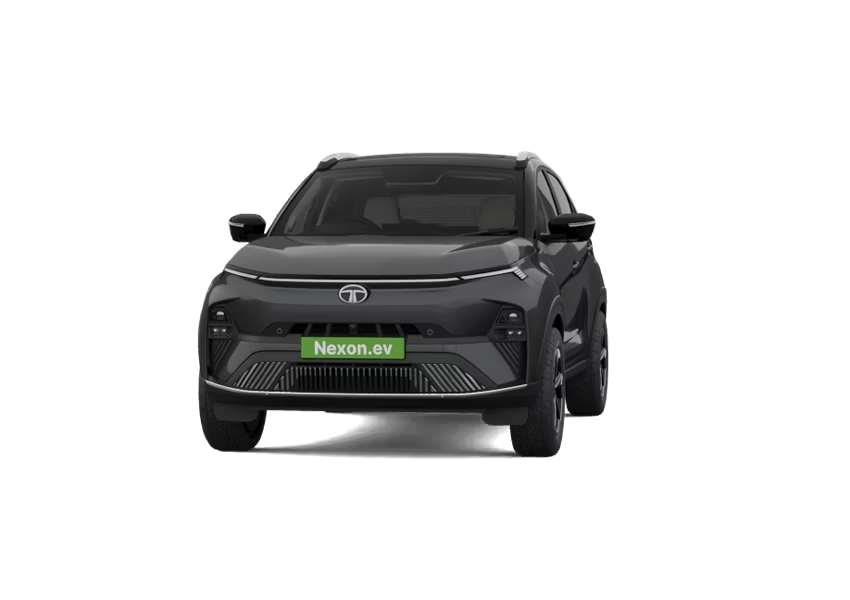
The Nexon EV represents maturity and ecosystem strength. It is a product that has evolved over time, refined through updates, and supported by Tata’s aggressive push into electrification.
The XUV400, on the other hand, feels like a performance-first alternative. It focuses on delivering a stronger driving experience, more space, and a slightly different value equation.
The problem for buyers is that both cars make sense, but in completely different ways.
Also read about why you should buy Tata Punch?
Battery, Range, and Real-World Confidence — Where the Decision Actually Begins
On paper, range numbers are often the first thing buyers compare, but in real-world usage, consistency matters more than claims.
- Tata Nexon EV offers a claimed range of around 465 km (long-range variant)
- Mahindra XUV400 offers slightly lower claimed figures but competitive real-world numbers
However, the key difference lies in confidence, not just numbers.
- Tata has built a more reliable real-world reputation
- Nexon EV owners have already validated range performance across conditions
- Charging network compatibility is smoother with Tata’s ecosystem
In contrast:
- XUV400 is still relatively newer in terms of EV ecosystem integration
- Real-world long-term ownership data is more limited
For a first-time EV buyer, this difference is critical. Range anxiety is not solved by numbers — it is solved by trust.
Performance and Driving Feel — Where XUV400 Strikes Back
This is where the equation changes significantly.
- Mahindra XUV400 offers:
- Stronger motor output
- Faster acceleration
- More engaging driving experience
- Tata Nexon EV offers:
- Smoother power delivery
- Better tuning for city driving
- More predictable throttle response
In real-world terms:
- XUV400 feels quicker and more responsive
- Nexon EV feels easier and more relaxed
If you enjoy driving, the XUV400 clearly stands out. But if your usage is primarily urban, the Nexon EV’s smoothness becomes more valuable.
Interior Experience and Cabin Practicality
Cabin experience is an area where buyer expectations have increased significantly.
Tata Nexon EV
- More modern dashboard design
- Better fit and finish
- Updated infotainment system
- Feels more polished overall
Mahindra XUV400
- Larger cabin space
- Better rear seat comfort
- More practical for families
So the trade-off becomes:
- Nexon EV → Premium feel
- XUV400 → More space
Depending on your usage, either could be the better choice.
Features and Technology — Substance vs Presentation
Features are no longer just about numbers, they are about usability.
- Nexon EV offers:
- More refined user interface
- Better integration of features
- Balanced feature list
- XUV400 offers:
- Essential features
- Less emphasis on premium feel
- More functional approach
This is a classic case of refinement vs practicality.
Ownership Experience — The Most Underrated Factor
This is where the biggest real-world difference exists.
Tata Advantage
- Strong EV ecosystem
- Wider charging support
- Larger service network
- Proven ownership experience
Mahindra Situation
- Growing EV presence
- Improving infrastructure
- Still developing ecosystem
For long-term ownership, this matters more than performance or features.
Cost of Ownership — The Real Value Equation
Both vehicles offer low running costs compared to petrol/diesel cars, but:
- Nexon EV offers more predictable ownership
- XUV400 may offer better driving satisfaction
Your decision depends on whether you value peace of mind or performance.
Who Should Buy Which?
Choose Tata Nexon EV if:
- You are buying your first EV
- You want reliability and ecosystem support
- Your usage is mostly city-based
- You prefer a polished product
Choose Mahindra XUV400 if:
- You enjoy driving
- You want more space
- You are okay with a slightly less mature ecosystem
- Performance matters more than features
FAQs
Q1. Which EV is better for long-term ownership?
Tata Nexon EV due to its stronger ecosystem and proven track record.
Q2. Which EV offers better performance?
Mahindra XUV400 offers better acceleration and driving feel.
Q3. Is range difference significant?
Not drastically, but Nexon EV has better real-world trust.
Q4. Which EV is better for families?
XUV400 offers more cabin space, making it slightly better for family usage.
Final Verdict
The Tata Nexon EV continues to dominate the segment not because it is perfect, but because it gets the fundamentals right. It offers reliability, ecosystem support, and a well-rounded ownership experience that makes it the safer choice for most buyers.
The Mahindra XUV400, however, brings something different to the table, a more engaging driving experience and better space. It appeals to a buyer who is willing to experiment slightly for a more dynamic experience.
In 2026, the smarter choice for most Indian buyers remains the Nexon EV. But for those who value performance and space, the XUV400 is a compelling alternative.
Author: Manav Akbari
