
Tata Punch EV vs Citroen ë-C3
The Indian compact SUV segment is packed with strong contenders, and the Tata Nexon sits right at the center of this competition. It goes up against popular rivals like the Hyundai Venue and Kia Sonet, both known for their feature-loaded cabins and modern turbo-petrol engines. The Maruti Suzuki Brezza appeals to buyers with its reliability and wide service network, while the Mahindra XUV 3XO stands out for its performance and safety package. Budget-focused options like the Nissan Magnite and Renault Kiger also attract attention with aggressive pricing and practical features. Despite this intense competition, the Nexon maintains an edge with its strong build quality, high safety ratings, and multiple fuel options including petrol, diesel, CNG, and electric.
On the electric side, the Citroën eC3 operates in a more niche but growing segment. Its closest competitor is the Tata Punch EV, which offers a more modern design and better feature list. Buyers willing to spend more often compare it with the Tata Nexon EV, which delivers higher range and a more premium experience. Upcoming and newer electric offerings like the Mahindra XUV 3XO EV and MG Windsor EV are expected to further intensify competition.
Interestingly, the eC3 also faces indirect competition from petrol-powered crossovers such as the Tata Punch, Maruti Suzuki Fronx, and Hyundai Exter, as many buyers in this price range still weigh practicality and affordability over going fully electric.
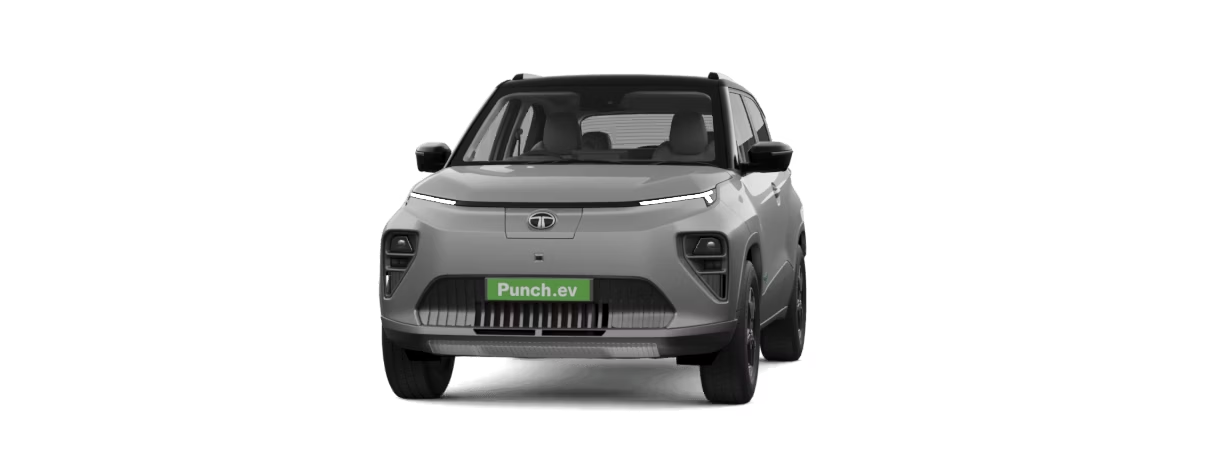
Visit the official Tata India website.
The budget EV segment in India is no longer a future concept, it is a present-day buying decision. With fuel prices remaining unpredictable and urban usage increasing, more buyers are now seriously considering electric cars under ₹15 lakh.
Two cars that consistently dominate this discussion are the Tata Punch EV and the Citroen ë-C3. At first glance, both target similar buyers, but their execution is completely different.
One focuses on delivering a modern, feature-loaded EV experience with strong range and technology. The other offers simplicity, comfort, and a more traditional driving feel.
This makes the decision less about specifications and more about how you plan to use your car daily.
Also read about Petrol vs CNG vs EV.
Price and Positioning
- Punch EV offers multiple variants with standard and long-range options
- ë-C3 follows a simpler lineup with fewer configurations
- Punch EV starts at a lower entry price
This gives Tata a clear advantage for buyers with flexible budgets.
Battery, Range and Charging
- Punch EV offers up to 421 km (ARAI)
- ë-C3 delivers around 320 km (ARAI)
- Punch EV supports fast charging
- ë-C3 has limited fast charging flexibility
For buyers concerned about daily usability and occasional highway trips, range becomes a decisive factor — and here, Punch EV clearly leads.
Features and Technology
Punch EV positions itself as a modern EV:
- Large infotainment system
- Digital instrument cluster
- 360-degree camera
- Connected car features
ë-C3 focuses on basics:
- Simple infotainment
- Limited digital integration
- Minimal advanced features
This difference reflects the core philosophy of both cars.
Safety and Build
- Tata’s reputation for safety continues with Punch EV
- Strong build quality and better safety features
- ë-C3 remains basic in this area
For family buyers, this is a significant factor.
Driving Experience
- ë-C3 offers better ride comfort on rough roads
- Punch EV provides better handling and urban usability
The Citroen feels more relaxed, while the Tata feels more complete.
Ownership Experience
- Tata has a wider service network
- Better resale value expected
- Easier long-term ownership
Citroen still has limited reach in comparison.
FAQs
Q1. Which EV offers better range?
Nexon EV currently offers a higher certified range.
Q2. Will Windsor EV be cheaper?
It is expected to be competitively priced.
Q3. Which EV is better for long-term ownership?
Nexon EV due to stronger network and proven reliability.
Q4. Should I wait for Windsor EV?
Only if pricing and features are significantly better.
Final Verdict
The Tata Punch EV clearly emerges as the more well-rounded and future-ready package. It offers better range, more features, stronger safety credentials, and a more reliable ownership experience.
The Citroen ë-C3, however, still holds value for buyers who prioritize comfort and simplicity over technology.
For most buyers in 2026, the Punch EV is the smarter long-term decision.
Author: Manav Akbari
