
Hyundai Creta Sales Dropped
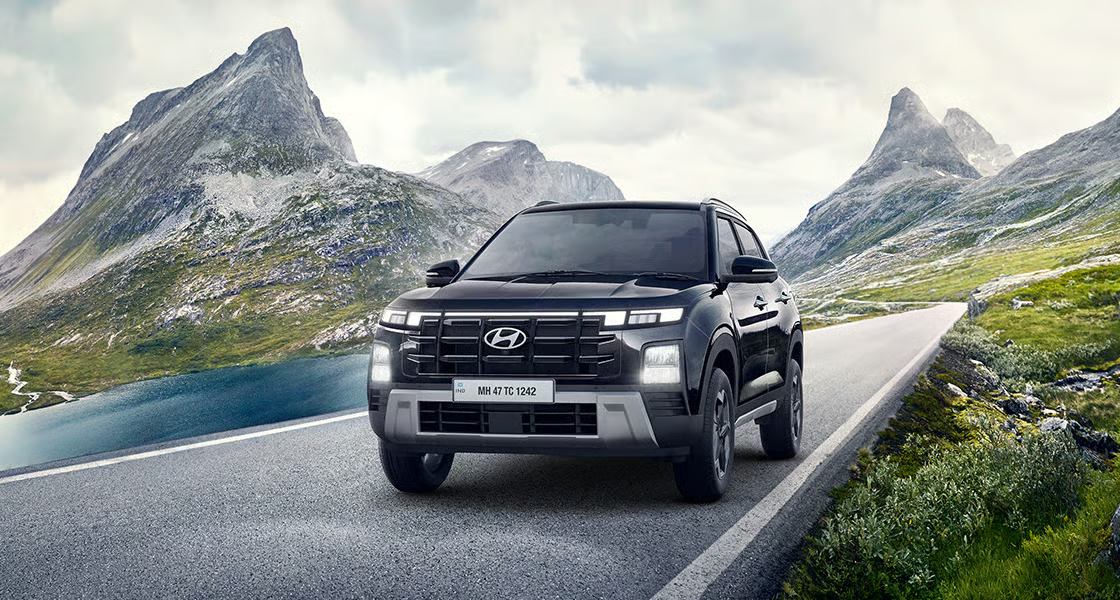
For years, the Hyundai Creta has been the default answer to the question, “Which midsize SUV should I buy in India?” But April 2026 told a different story. While the overall passenger vehicle market posted its highest-ever April sales, the Creta quietly slipped, down 10% year-on-year. In a month where nearly everyone grew, the Hyundai Creta sales drop April 2026 is one of the most telling signals the market has sent in a while.
Let’s talk about who is actually winning its buyers, and what that means for you.
Also read about the MG Windsor EV vs Tata Nexon Ev.
The Numbers: What Actually Happened in April 2026
India’s passenger vehicle market opened FY2027 on fire. Total retail dispatches hit 4,41,721 units in April, a 25% year-on-year surge, the highest-ever April figure on record. Maruti’s Dzire topped the charts with 23,580 units. Tata Punch grew 53% year-on-year. Kia Seltos exploded to a 72% YoY jump.
The Creta? It retailed 15,291 units in April 2026, still the bestselling midsize SUV, but down from approximately 17,000 units in April 2025. In a market that grew 25%, losing ground year-on-year isn’t just a blip. It’s a signal.
For context: this is not the Creta disappearing from the charts. It still holds the #1 midsize SUV tag. But holding first place while shrinking, in a booming market, means someone else is getting the buyers who would have once walked straight to a Hyundai dealership.
Who Is Eating the Creta’s Lunch?
The most obvious answer staring at us from the April 2026 data is Kia Seltos. Hyundai’s own sibling brand posted a jaw-dropping 72% year-on-year growth in April, easily crossing 10,000 units. Here’s the uncomfortable truth Hyundai won’t say publicly: the Seltos has become the Creta for buyers who want a bit more.
The 2024 Seltos facelift sharpened the car’s positioning significantly. It looks sportier, packs a panoramic sunroof, and in its top trims, feels legitimately premium. A buyer walking into a Hyundai showroom for a Creta is now often walking into a Kia showroom next door and walking out with a Seltos.
But the Kia story isn’t the only one. Tata’s combined Nexon sales (petrol, diesel, CNG, and EV combined) hit 18,126 units, surpassing the Creta individually. Tata has quietly built a juggernaut with the Nexon by covering every buyer segment under one badge. CNG buyers, EV-curious buyers, budget-conscious buyers, and even diesel loyalists, they’re all served by one nameplate. The Creta’s single fuel-type framing (primarily petrol and mild hybrid) makes it look incomplete by comparison.
Mahindra is also a factor, though indirectly. The XUV 3XO has given buyers a fresh, aspirational alternative just below the Creta’s price band, pulling some consideration away even before a test drive.
The Creta Electric Question
Here’s where it gets complicated. A portion of Creta sales in the April data includes the Creta Electric. Hyundai does not separately report Creta EV volumes consistently, but trade sources suggest the electric variant has been dragging the combined tally rather than boosting it.
Why? Because the Creta Electric starts at approximately Rs 17.99 lakh, expensive enough that buyers considering it are cross-shopping against the MG Windsor EV, the Mahindra BE 6, and even the upcoming Kia Syros EV. The ICE Creta buyer and the EV buyer are two different people, and the Creta EV hasn’t fully unlocked the second group.
Hyundai finds itself in a tricky spot: the ICE Creta is being pressured from below (Nexon, Sonet upgrades) and from the same family (Seltos). The EV variant hasn’t hit the penetration numbers needed to compensate.
What This Means for Indian Buyers
If you’re currently in the market for a midsize SUV and the Creta was your default pick, April 2026 is actually good news for you. Increased competition means better features, faster updates, and more pressure on Hyundai to sharpen the Creta’s next iteration. Hyundai knows this, the company has quietly been offering stronger deals and expanded colour/variant options to maintain floor traffic.
But here’s our honest take: the Creta’s dominance is no longer automatic. The Kia Seltos now competes at nearly every price point the Creta occupies, and it looks fresher doing it. The Tata Nexon offers more powertrain flexibility at a lower entry price. If you’re buying with a 3-year horizon in mind, the Seltos and a well-spec’d Nexon deserve equal time on your shortlist, not just a courtesy test drive.
The Creta is not bad. It’s just no longer the only answer.
Is This a Blip or a Trend?
One month of data doesn’t make a trend, but the Creta’s trajectory over the past 4–6 months is worth watching. Industry watchers note that Hyundai’s market share slipped from 12.45% in April 2025 to 11.65% in April 2026, even as the overall pie grew significantly. Meanwhile, Kia’s share grew slightly from 6.16% to 6.19% in the same period.
The Hyundai-Kia group as a whole may be maintaining its India footprint, but within that group, power is shifting. The Creta may soon need a facelift, or a bold new generation, to reclaim the ceiling it used to occupy.
What This Means for Indian Buyers
April 2026’s data is more than a sales chart. It’s a reminder that brand inertia only lasts so long. The Creta had 8+ years of near-unchallenged dominance to build that inertia. What we’re seeing now is the market rewiring, and the Hyundai Creta sales drop April 2026 is the clearest data signal of that shift yet.
Keep an eye on May and June numbers. If the Creta continues to lose share in a rising market, Hyundai will be forced to act decisively, which likely means an early model refresh or aggressive pricing on the Creta EV. Either outcome benefits you as a buyer.
Final Verdict / Our Take
The Creta is still the midsize SUV benchmark, but it’s a benchmark that’s slowly being redrawn. The Seltos’ 72% YoY surge is not an accident; it’s the result of Kia consistently delivering better product updates faster. Tata’s Nexon growing to 18,000+ units tells you buyers want choice, not just a familiar badge.
If Hyundai doesn’t respond sharply, either with a mid-cycle Creta upgrade or an aggressive Creta EV price cut, the 10% drop of April 2026 could look like the beginning of a longer slide. For now, it’s a wake-up call. The question is whether Hyundai answers it.
Frequently Asked Questions (FAQs)
Q1. Why did Hyundai Creta sales drop in April 2026 despite record market growth?
The Hyundai Creta sales drop April 2026 happened primarily because rivals like Kia Seltos (up 72% YoY) and Tata Nexon (18,126 units) captured buyers who previously defaulted to the Creta. In a fast-growing market, the Creta’s relative flat performance means it’s losing buyer mindshare even though it remains the top-selling midsize SUV.
Q2. How does the Kia Seltos compare to the Hyundai Creta in price and features in 2026?
The Kia Seltos and Hyundai Creta occupy nearly identical price bands, roughly Rs 10.79 lakh to Rs 20+ lakh (ex-showroom). The Seltos edges ahead in interior feel and design freshness in 2026, while the Creta has a wider service network and brand recall. In terms of pure features at equivalent prices, the Seltos is now equal or marginally ahead in most trim comparisons.
Q3. Is the Hyundai Creta Electric affecting the regular Creta’s sales?
Partially, yes. The Creta Electric starts at approximately Rs 17.99 lakh, which puts it in a higher consideration bracket where buyers cross-shop with the MG Windsor EV and Mahindra BE 6. While Hyundai reports combined Creta numbers, the EV’s premium pricing hasn’t compensated for slowing ICE Creta volumes, contributing to the overall decline.
Q4. Should I wait to buy a Hyundai Creta or buy now?
If you’re looking at the ICE Creta today, Hyundai is likely to respond to its declining numbers with sharper deals and possible variant updates in the coming months. Buying now versus waiting 2–3 months could get you into a Creta at a marginally better price or with improved features. However, if the Seltos or Nexon is already on your list, don’t delay, both are delivering strong value right now.
— Manav Akbari, TheWheelFeed
