
Electric Cars in India 2026 Problems
Electric vehicles have become one of the biggest talking points in the Indian automotive industry. From government incentives to aggressive marketing campaigns, everything points towards one narrative, EVs are the future, and that future is already here.
But if you look beyond the headlines and speak to actual owners, a different picture starts to emerge.
In 2026, electric cars are no longer experimental. They are functional, practical, and in many cases, surprisingly good for daily use. However, they are still not universally suitable for every type of buyer.
The problem is not with the technology itself. The problem is with how expectations are set.
Most buyers approach EVs expecting them to behave exactly like petrol or diesel cars, same convenience, same flexibility, same usage patterns. That is where the mismatch begins.
Owning an EV in India today requires a different mindset, a different routine, and in some cases, compromises that are not immediately obvious during the buying process.
This is not an argument against electric cars. It is a reality check, one that can help buyers avoid making the wrong decision.
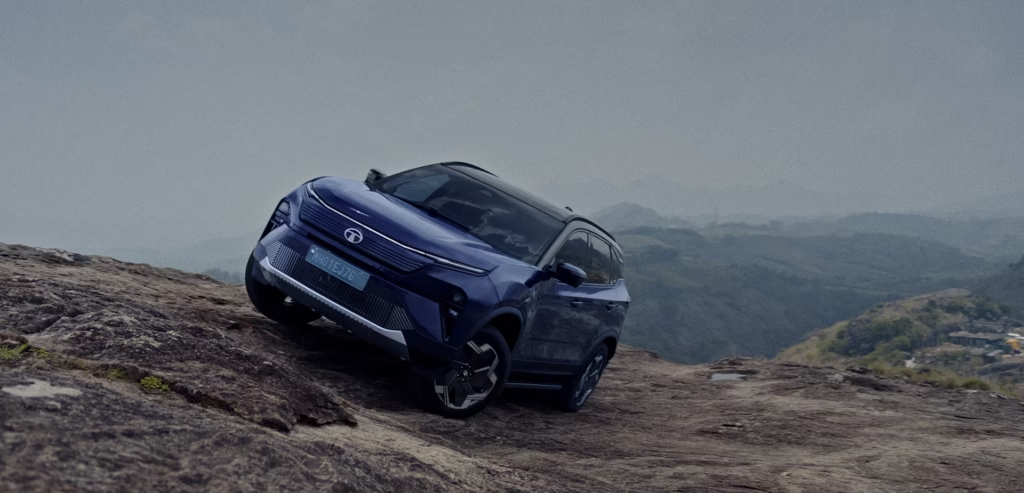
Visit the official Tata India website.
Also read about the Upcoming Electric SUVs in India.
Charging Infrastructure — The Most Talked About Problem, but Not Fully Understood
Charging infrastructure is often cited as the biggest limitation of EVs in India, and while that is true, the real issue is more nuanced.
- Charging stations are increasing, but distribution is uneven
- Metro cities have better coverage, but smaller cities still lag
- Reliability of chargers is inconsistent
The biggest challenge is not just availability, it is predictability.
When you drive a petrol car, you don’t think about refueling. It is quick, accessible, and reliable.
With an EV:
- You need to plan your charging stops
- You need to account for waiting time
- You need backup options
This mental effort is something most buyers underestimate.
Range Anxiety — Not Just a Number Problem
Manufacturers advertise impressive range figures, but real-world driving conditions tell a different story.
- Traffic reduces efficiency
- Air conditioning impacts battery usage
- Driving style plays a major role
For example:
- Aggressive driving can reduce range significantly
- Highway speeds drain battery faster
This creates a situation where:
- You start monitoring range constantly
- You adjust driving behavior to conserve battery
Over time, this changes how you interact with your car.
Charging at Home — The Real Make-or-Break Factor
This is one of the most critical aspects of EV ownership.
If you have:
- A dedicated parking space
- Ability to install a home charger
Then EV ownership becomes significantly easier.
But if you don’t:
- You depend on public charging
- Your convenience drops drastically
For many urban apartment users, this is still a major limitation.
Cost Advantage — Real, but Not Immediate
EVs are often promoted as cheaper to run, which is true, but only under certain conditions.
- Cost per kilometer is significantly lower
- Maintenance is simpler (fewer moving parts)
However:
- Initial purchase cost is higher
- Savings take time to recover
For low-usage buyers:
- The financial benefit may take years to realize
This makes EVs less attractive for occasional users.
Long-Distance Travel — Where EVs Still Feel Limited
This is where EVs still struggle compared to traditional cars.
- Requires detailed route planning
- Charging stops increase travel time
- Limited charging infrastructure on highways
Even when chargers are available:
- Waiting time can be unpredictable
- Fast charging may not always be accessible
For buyers who frequently travel long distances, this can become frustrating.
Ownership Adjustment — The Hidden Psychological Shift
One of the least discussed aspects of EV ownership is how it changes your behavior.
- You start planning trips differently
- You become more aware of energy consumption
- You adapt your driving style
Some buyers enjoy this change. Others find it restrictive.
This is not a technical limitation, it is a lifestyle adjustment.
Who Should Definitely Consider an EV in 2026
EVs make strong sense if:
- You drive mostly within the city
- Your daily usage is predictable
- You have access to home charging
- You want lower running costs
For these users, EVs can be extremely satisfying.
Who Should Avoid EVs (For Now)
EVs may not be ideal if:
- You frequently travel long distances
- You don’t have reliable charging access
- You prefer flexibility without planning
- Your usage is highly unpredictable
For these buyers, petrol or hybrid options may still be better.
What Most Buyers Realize Too Late
This is where the real insight lies.
- EVs are not inconvenient, they are different
- The problem is not technology, it is expectation mismatch
Buyers who understand this early are satisfied.
Buyers who don’t often feel restricted.
FAQs
Q1. Are electric cars practical in India in 2026?
Yes, but primarily for city use with predictable driving patterns.
Q2. What is the biggest problem with EVs?
Charging infrastructure and planning requirements.
Q3. Do EVs actually save money?
Yes, but only over time and with sufficient usage.
Q4. Should I buy an EV now or wait?
Buy now only if your usage fits current EV capabilities.
Final Verdict
Electric cars in India in 2026 are no longer a futuristic concept, they are a practical solution for the right type of buyer.
However, they are not a universal replacement for petrol or diesel cars yet.
The biggest mistake buyers make is assuming EVs will fit into their existing lifestyle without changes. In reality, EV ownership requires adaptation, in how you drive, how you plan, and how you use your vehicle.
If your usage aligns with what EVs offer today, they can be one of the most satisfying automotive experiences available. But if your needs demand flexibility, spontaneity, and long-distance convenience, it may still be worth waiting.
The smartest decision is not based on trends, but on how well the vehicle fits your real-world life.
Author: Manav Akbari
