
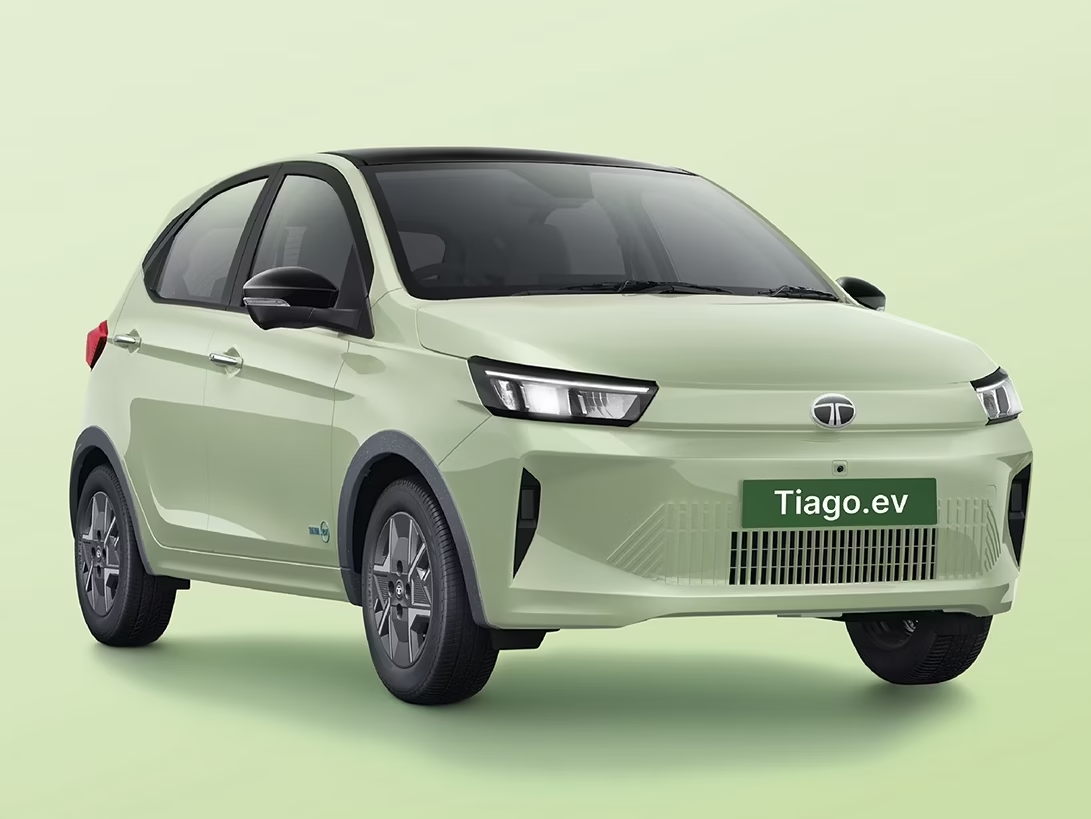
New Tata Tiago EV 2026 price
₹8 lakh for an electric hatchback with a 360° camera, LED DRLs, and Tata‘s 5-star safety legacy, the 2026 Tiago EV facelift is doing things its price has no business doing.
Also read about the New BMW M440i in India.
What’s New on the 2026 Tata Tiago EV Facelift?
The original Tiago already stood out. In a segment full of forgettable, boxy hatchbacks, the Tiago had personality, and this facelift takes that personality and polishes it without killing the enthusiasm. Up front, you get pixel-shaped fog lamps, eyebrow-style LED DRLs, and a revised bumper that looks noticeably more contemporary. The rear gets updated LED tail lights with a cleaner light bar treatment. And inside, Tata has added a 360° camera, something you genuinely wouldn’t expect at this price point.
This isn’t a desperate refresh to keep an ageing car relevant. This is a car that already worked, being made better with clear intent.
The Price Still Makes Sense. Here’s Why
The current Tata Tiago EV starts at ₹7.99 lakh and tops out at ₹11.14 lakh (ex-showroom). Post-facelift, expect a modest bump of ₹15,000–₹30,000 depending on the variant. Practically speaking, the new Tata Tiago EV 2026 price should still sit comfortably under ₹12 lakh even at the top trim, which keeps it in a league very few EVs in India can compete in right now.
For comparison, the MG Comet EV opens at ₹7.50 lakh. But the Comet is a micro city-car. The Tiago EV gives you a proper four-door hatchback with actual road capability. That’s a meaningful difference for the money.
Who Is This Car Actually Built For?
Think of the Tiago EV as the Alto’s smarter, safer, better-looking sibling. If you’re eyeing the Alto purely for its low running cost and compact footprint, the Tiago EV does everything the Alto does, and then some. It looks cool, it’s built by one of India’s safest carmakers, and it comes with an electric powertrain that cuts your running cost to a fraction of what petrol demands.
For a family of two or three, this car is a near-perfect fit. Daily city runs, short trips, office commutes, weekend errands, the Tiago EV handles all of it without making a fuss. The cabin is compact but not claustrophobic, and the silent, smooth electric drivetrain makes stop-and-go traffic far less draining than you’d expect from a car in this price range.
Then there’s the second-car buyer, someone who already owns a petrol or diesel car for highway use and wants a low-cost city vehicle to pair with it. If you’re covering 30–50 km within city limits daily, the Tiago EV’s running cost works out to roughly ₹1–₹1.20 per km at current electricity rates. Compare that to ₹7–9 per km in a petrol car, and the numbers make a very convincing argument on their own.
Range, Battery and Real-World Performance
The 2026 Tiago EV continues with two battery options, the 19.2 kWh pack claiming 250 km, and the 24 kWh pack claiming 315 km. Real-world range in Indian city conditions with the AC running typically settles around 180–210 km, which is honestly more than enough for the kind of use this car is built for.
For daily commutes and household runs, range anxiety doesn’t really apply here. Plug in overnight, wake up to a full charge, and go. That’s the Tiago EV ownership loop, and existing owners who’ve crossed 40,000 km on the current version report very few complaints about reliability. The platform is proven.
How It Stacks Up Against the Competition
The Tiago EV’s main rivals sit at opposite ends of the compact EV space. The MG Comet EV is cheaper to park and nimbler in tight lanes, but it can’t do highways comfortably and has almost no boot space for practical use. The Tata Punch EV starts at ₹9.99 lakh, considerably more expensive, with a bigger footprint.
The Tiago EV sits in a genuine sweet spot between the two. Not as limited as the Comet, not as pricey as the Punch EV. And it carries Tata’s safety legacy, the only Indian brand to have consistently scored 5 stars in Global NCAP testing. When you’re putting a family of two or three in a compact hatchback, that track record matters.
What This Means for Indian Buyers
The Tiago EV facelift is a sharpening, not a reinvention. Tata has taken a car that already had the right fundamentals, safety, low running cost, distinct looks, and made it feel fresh for 2026. For anyone considering an affordable EV for city use, this launch removes most of the remaining reasons to wait.
Final Verdict / Our Take
If your shortlist is under ₹12 lakh and you’re even mildly open to an EV, the new Tata Tiago EV 2026 is the default answer. Low running cost, genuinely good safety, a design that stands out, and now a more premium feel inside and out. Whether you’re buying your first car, looking for a smart city companion alongside your existing vehicle, or replacing a basic hatchback, this covers all three scenarios well.
Book a test drive on May 28. And if you’re ready to pull the trigger, do it before post-launch price adjustments kick in. You’re unlikely to find a better entry point into electric mobility at this price in India right now.
Frequently Asked Questions (FAQs)
Q1. What is the new Tata Tiago EV 2026 price in India?
The current Tata Tiago EV price ranges from ₹7.99 lakh to ₹11.14 lakh (ex-showroom). With the facelift launching on May 28, 2026, the new Tata Tiago EV 2026 price is expected to see a minor hike of ₹15,000–₹30,000 across variants. Official prices will be announced at launch.
Q2. What’s new in the 2026 Tiago EV? what did Tata actually change?
The facelift brings pixel fog lamps, eyebrow LED DRLs, and a refreshed front bumper up front, along with updated LED tail lights at the rear. Inside, the biggest addition is a 360° camera, a first for the Tiago EV and a genuine upgrade over the outgoing model.
Q3. What is the real-world range of the Tata Tiago EV 2026?
The 19.2 kWh battery claims 250 km, while the 24 kWh pack claims 315 km. In real-world Indian city driving with AC on, expect 180–210 km from the smaller pack. For daily commutes under 50 km, either battery is more than sufficient.
Q4. Should I buy the new Tata Tiago EV 2026 or wait for another affordable EV?
If you need a city car under ₹12 lakh with low running cost, there’s no strong reason to wait. No rival at this price matches the Tiago EV’s combination of safety, design, and real-world practicality. If you regularly need highway range or five-seat space, the Tata Punch EV is worth saving up for instead.
Stay tuned and follow up for more.
