
Bharat NCAP 2.0
Also visit the official website of Ministry of Road Transport and Highways
Bharat NCAP 2.0 will be the biggest change to India’s crash-rating system since it began in 2023, and the date is now official: October 2027. Union Minister Nitin Gadkari confirmed on 3 September 2026 that from then, the entire safety chain will be evaluated, not just how well occupants survive a crash.
The detail that matters most for buyers is the scoring. Today a 5-star car is judged on occupant protection alone. Under the new framework, even a perfect crash score will not be enough to earn five stars. Here is the arithmetic.
What was announced and what is only proposed
As Deccan Chronicle reported on 3 September 2026, Gadkari said Bharat NCAP 2 will assess the whole safety chain from October 2027. He also cited about 500,000 road accidents and roughly 180,000 deaths a year in India, along with a graded licence point system for drivers.
The scoring framework, as laid out in Autocar India’s report and a separate explainer from carhp, builds on a draft the ministry proposed in late 2025. The weightings and thresholds below come from those reports, so treat them as the framework as currently described rather than a final gazette text.
The new 100-point scorecard
Bharat NCAP 2.0 uses five pillars worth 100 points: crash protection 55, vulnerable road user (pedestrian and cyclist) protection 20, safe driving features 10, accident avoidance technology 10, and post-crash safety 5.
The star bar is steep. From the launch until 2029, a car needs at least 70 points for five stars. From 2029 the minimum rises to 80. Curtain airbags and electronic stability control (ESC) become compulsory for a car to be rated at all.
The crash tests also toughen up. Reports list a 50 km/h full-width frontal test, a rear-impact test at 50 km/h, and an oblique pole impact at 32 km/h, up from the current 29 km/h side pole speed.
The maths that changes the game
Here is the insight a straight news rewrite misses. Crash protection is only 55 of the 100 points. Even a car that aces every crash test and scores the full 55 still needs 15 more points from the other four pillars to reach 70.
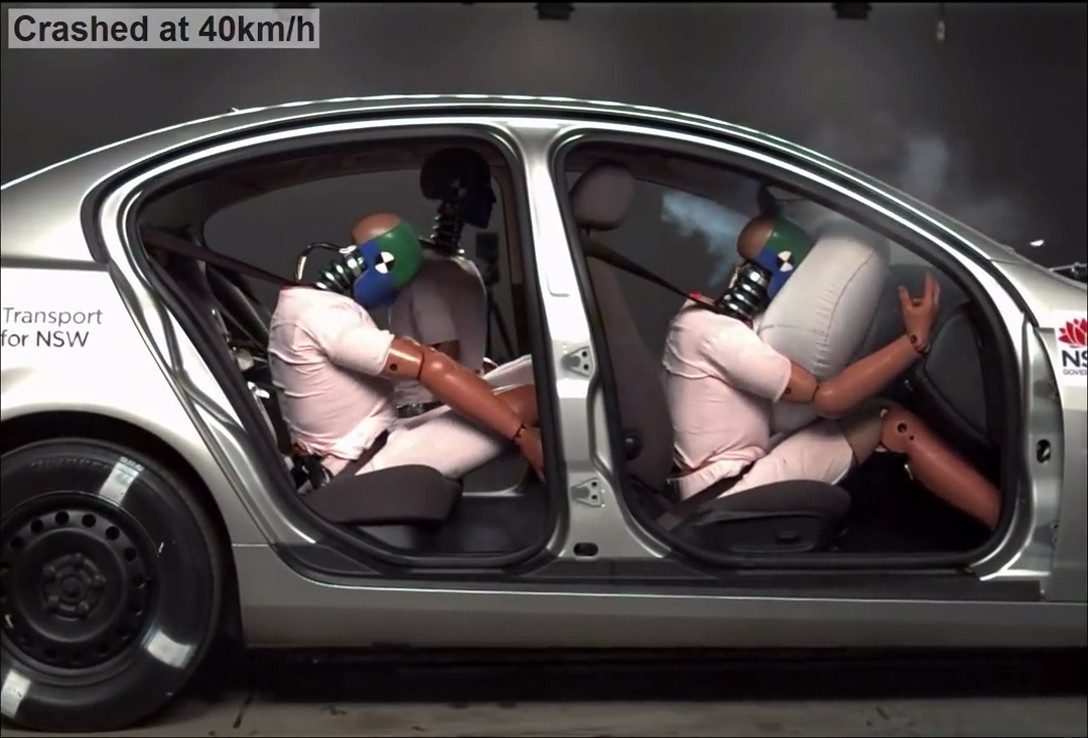
Those pillars offer 45 points in total, so the car must collect a third of them. From 2029, with an 80-point bar, a flawless crash performer needs 25 of those 45 points, or more than half. Put simply, a body shell built like a vault will no longer be enough. Pedestrian-friendly design, braking and driver-assistance technology, and post-crash features will decide the stars.
Today the picture is different. The current protocol scores adult occupants out of 32 and children out of 49, a total of 81, and stars follow those two numbers. That is why a car can win five stars on structure and restraints alone.
What today’s five-star cars tell us
Look at two recent results. The 2026 Brezza scored 30.41 out of 32 for adults and 43 out of 49 for children, according to Autocar India. The Kia Seltos scored 31.70 and 45. Both are comfortably five-star under the present rules, and both already carry six airbags and ESC, which the new rules will demand.
What neither result measures is the new weight on pedestrians, avoidance technology and post-crash response. We cannot predict how today’s top scorers will fare under the new card, and nobody can until tests begin. Cars with strong structures but little active safety will be most exposed. Our look at the safest Bharat NCAP cars of 2026 shows the current leaders, and our piece on the Kia Sonet’s 1-star result shows how wide the gap between best and worst already is.
What it means for buyers and carmakers
The current programme is reported to run until 30 September 2027, so there is a full year of old-style testing still to come. Expect manufacturers to rush results under the present rules while they can, and expect marketing to lean hard on five-star badges during that window.
For buyers, the practical effect lands about a year from now, when new tests start. Any car launched before then will carry the old-style rating, so do not compare a 2026 five-star directly with a 2028 five-star. The latter will have survived a harder exam.
For carmakers, the pressure is on entry-level models. Making curtain airbags and ESC standard is cheap on a ₹20 Lakh SUV and painful on a ₹6 Lakh hatchback. Maruti has been upgrading, as we noted in our Maruti safety upgrade analysis, but the new scorecard will test whether those upgrades reach every trim and not just the top one.
One more thing to watch is transparency. A 100-point score with five sub-scores gives buyers far more information than a single star count, provided the ministry publishes each pillar clearly. A car that scores 72 with weak pedestrian protection is not the same as one scoring 72 with weak avoidance technology, and buyers should be able to see that difference.
Expect more brands to add driver-assistance features to lower variants, and expect some price creep as a result. That is a trade most buyers should accept, but it is worth watching.
Final Verdict
Bharat NCAP 2.0 raises the standard from crash-test survival to full-chain safety, and the 100-point system makes it impossible to earn five stars on body strength alone. We think that is the right direction for a country that loses about 180,000 people a year on its roads.
Our advice is simple. Until October 2027, treat today’s five-star ratings as a good baseline, check that your car has curtain airbags and ESC, and look at the active-safety list as carefully as the star count.
Stay tuned and follow up for more.
When does Bharat NCAP 2.0 start?
Union Minister Nitin Gadkari said on 3 September 2026 that Bharat NCAP 2.0 will roll out from October 2027.
How are points split under Bharat NCAP 2.0?
As reported, crash protection gets 55, vulnerable road user protection 20, safe driving 10, accident avoidance technology 10 and post-crash safety 5, out of 100.
How many points are needed for five stars?
Reports say 70 points from launch until 2029, rising to 80 points from 2029. Curtain airbags and ESC are required for a car to be rated.
Do current five-star cars keep their ratings?
Existing ratings were earned under the present protocol, which scores adult and child occupant protection. How those cars would score under the new 100-point system is unknown until they are retested.
Stay tuned and follow up for more.
