
FASTag local annual pass 2026
Also visit the official website of MoRTH
A toll pass at ₹1,500 a year sounds like a gift, until you see the same scheme charges ₹3,000 if your plaza sits inside town limits. The FASTag local annual pass 2026, notified by MoRTH and live from 1 November, saves serious money for some commuters and very little for others.
What MoRTH Has Actually Notified
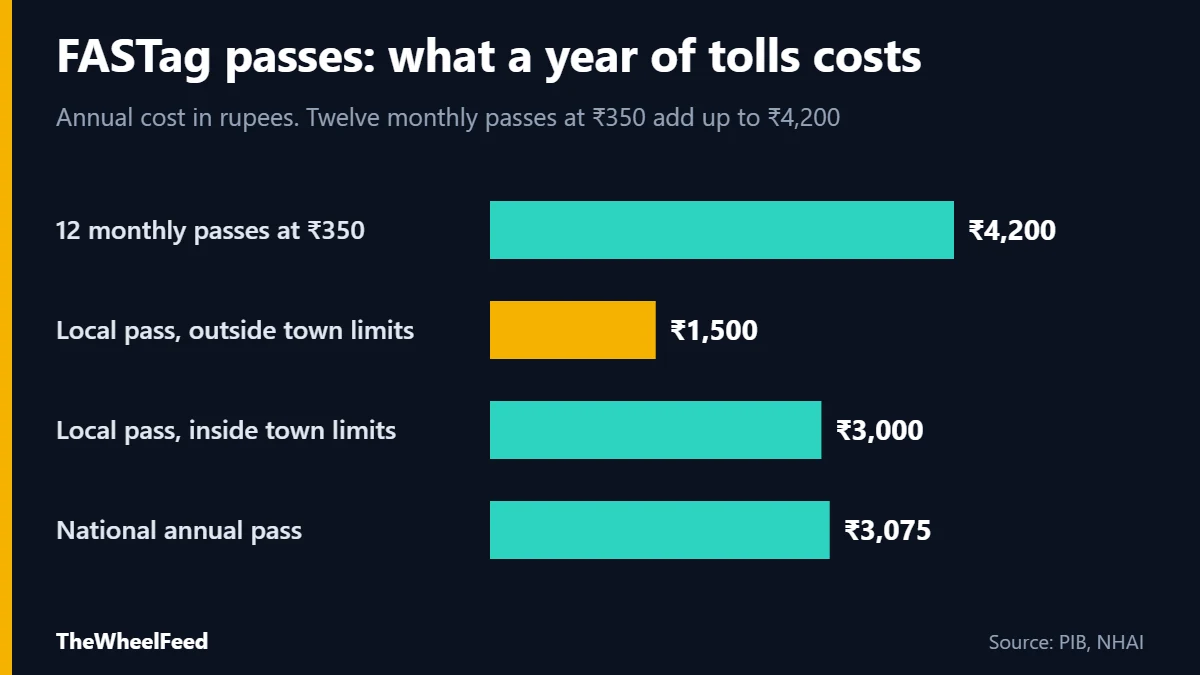
The FASTag local annual pass 2026 is a concessional pass for non-commercial vehicle owners who live within 20 km of a national highway fee plaza. It costs ₹1,500 a year at plazas outside municipal or local town limits and ₹3,000 inside them, works at one named plaza, and cannot be transferred to another.
The PIB release of 27 October 2026 says the rule comes through the National Highways Fee (Fifth Amendment) Rules, 2026. Eligible owners with a valid, working FASTag can choose either the existing monthly pass or this local pass for a given plaza. The Centre can revise the annual fee, with changes taking effect on 1 April.
Eligibility and How to Apply
You need a non-commercial vehicle, a valid FASTag and a home within 20 km of the plaza. No pass is issued for highways or expressways using a closed user-fee system, or where a service road or alternative road is available to commuters.
Passes are available at eligible plazas from 1 November and on the Rajmargyatra app from 1 December 2026. The release does not say what proof of residence you need, how the 20 km is measured, or what counts as “municipal limits”. NHAI’s digital monthly local pass already checks addresses through DigiLocker, VAHAN and a map-based radius test. Expect something similar, but that is our expectation, not a notified rule. Carry your RC and an address proof on the first visit.
The Break-Even Maths
Take a real plaza. At Choryasi on NH-48 near Surat, rates effective 1 April 2026 list a car at ₹125 for a single journey and ₹185 for a return. The local monthly pass costs ₹350. Launch coverage quoted ₹360 a month, so the price clearly varies by plaza.
At ₹125 a crossing, the ₹1,500 pass breaks even after 12 crossings, or 9 return trips at ₹185. The ₹3,000 pass needs 24 crossings, or 17 return trips. Against the monthly pass, the annual one wins on price. Twelve months at ₹350 costs ₹4,200, so you save ₹2,700 at a ₹1,500 plaza and ₹1,200 at a ₹3,000 plaza. At ₹360 a month the savings are ₹2,820 and ₹1,320.
Who Saves the Most
Existing monthly pass holders outside town limits gain the most, cutting a yearly bill of about ₹4,200 to ₹1,500, a fall of 64%. Picture a teacher living in a village 12 km from a plaza who crosses it twice every working day. She pays ₹350 a month today, while the ₹1,500 pass works out to ₹125 a month.
The comparison with the national annual pass is more interesting. NHAI’s March 2026 release puts that pass at ₹3,075 for one year or 200 crossings. A ₹3,000 local pass is only ₹75 cheaper. But a commuter crossing twice a day for 22 working days makes 44 crossings a month, and exhausts the national pass in roughly 4.5 months. The local pass release mentions no crossing cap. At a ₹3,000 plaza, someone crossing fewer than 200 times a year may as well pay ₹75 more for the national pass, which works at every plaza.
Who Should Not Bother
Skip the pass if you cross the plaza fewer than 12 times a year (₹1,500 plazas) or 24 times (₹3,000 plazas), because paying per trip is cheaper. Skip it if you need the plaza for fewer than 5 months a year at a ₹1,500 plaza, or fewer than 9 at a ₹3,000 plaza. Monthly passes cost less over that period (4 months at ₹350 is ₹1,400).
It also does not suit you if you cross several plazas, since this pass is plaza-specific, or if a free alternative road exists. That exclusion is the one to read twice, because the release does not say who decides what counts as an alternative. The release speaks only of non-commercial vehicles, so EV owners are not excluded. Toll plazas are also among the sites in line for subsidised chargers under PM E-DRIVE, though none were installed by late July.
What This Means for Indian Buyers
Small-town buyers are driving car sales, and rural India is buying more cars than cities, so some new owners live beside a national highway plaza. For them, toll is a running cost worth planning: at best it falls from about ₹4,200 a year to ₹1,500. Check your plaza’s status before you assume the saving.
Final Verdict
The FASTag local annual pass 2026 is a good deal if you live within 20 km, cross one plaza regularly, and have no free alternative road. Take it if you cross a ₹1,500 plaza more than 12 times a year, or a ₹3,000 plaza more than 24 times. Everyone else should stay with per-trip tolls, a monthly pass, or the national pass, and check your plaza’s own price board before paying anything.
Who is eligible for the FASTag local annual pass 2026?
Owners of non-commercial vehicles with a valid, working FASTag who live within 20 km of a national highway fee plaza. The plaza must be one where the scheme is issued, and no pass is given on closed user-fee highways or where a service road is available.
How much does the local annual pass cost?
It costs ₹1,500 a year at plazas outside municipal or local town limits and ₹3,000 inside them. It works only at the plaza it is issued for, and the Centre can revise the fee from 1 April each year.
How do I apply for the FASTag local pass?
You can buy it at eligible toll plazas from 1 November 2026, or through the Rajmargyatra app from 1 December 2026. The release does not list documents, so carry your RC, FASTag details and address proof.
Is the local pass cheaper than the ₹3,075 national FASTag annual pass?
At a ₹1,500 plaza, yes, by ₹1,575. At a ₹3,000 plaza the saving is only ₹75, and the national pass works at other plazas too, but it ends after 200 crossings.
Stay tuned and follow up for more.
