
Tata Punch best selling car India
Also visit the official website of Tata Motors
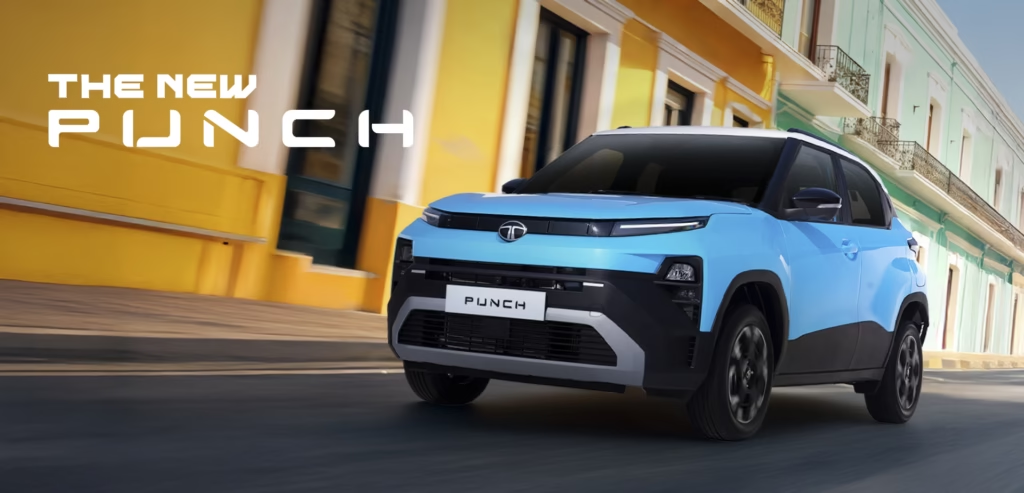
For the first time in a long while, Maruti Suzuki isn’t sitting at the top of India’s sales chart, and the car that dethroned them isn’t even a sedan.
More from us: Skoda’s ₹67 Lakh Kodiaq RS Sold Out in 6 Minutes. But Should You Actually Want One?
The Numbers That Changed Everything
In June 2026, the Tata Punch became India’s best-selling car, moving 21,006 units and posting a staggering 101% year-on-year growth. Right behind it, the Tata Nexon claimed second spot with 18,335 units, up 58% YoY. That pushed the long-reigning Maruti Suzuki Dzire down to third place with 17,899 units, still a healthy 16% YoY growth, but simply not enough to hold off Tata’s twin surge. When we say Tata Punch is now India’s best-selling car, that’s not opinion, that’s June 2026’s retail data.
Why This Isn’t a Fluke
A single strong month doesn’t rewrite a segment, but a 101% jump does demand attention. The Punch has quietly built a reputation as the practical, safety-conscious buyer’s default choice, a 5-star GNCAP rating, a compact footprint that works in Indian cities, and a price point that undercuts most rivals while still feeling feature-rich. The Nexon’s 58% growth backs this up: Tata isn’t winning on one lucky model, it’s winning across its micro-SUV and compact SUV range simultaneously.
What This Means for Maruti
Maruti Suzuki isn’t in trouble, the Dzire’s growth is still positive, and Maruti continues to dominate the mass-market hatchback and CNG space overall. But the psychological shift matters. For over a decade, “best-selling car in India” has almost always meant a Maruti nameplate. Losing that top spot to a Tata SUV signals that Indian buyer preference is tilting harder toward SUVs and away from traditional sedans and hatchbacks than even the sales charts suggested a year ago.
The Buyer Scenario That Explains This
Picture a first-time car buyer in a Tier-2 city like Nashik or Coimbatore, budget capped around ₹8-9 lakh. Three years ago, that buyer defaulted to a Swift or a WagonR. Today, that same buyer is cross-shopping the Punch because it gives them SUV styling, a higher seating position, and genuine safety credentials, without stretching much beyond hatchback pricing. That shift in buyer psychology, multiplied across hundreds of thousands of first-time buyers, is exactly what’s showing up in June’s numbers.
Segment-Wide Momentum
It’s not just Tata. Wagon R held fourth with 16,952 units, Ertiga took fifth with 16,111, and the Swift rounded out sixth with 15,215, all still Maruti products posting solid growth. Mahindra’s Scorpio landed seventh with 14,097 units and 11% YoY growth, showing Mahindra’s SUV push is also gaining ground. The overall retail market crossed the 4 lakh mark for the month, with Tata registering the highest growth among the top three OEMs. Rounding out the top 10 were the Maruti Fronx, Maruti Baleno, and Hyundai Venue, a list that, taken together, confirms SUVs and SUV-styled hatchbacks now dominate India’s best-seller charts more comprehensively than at any point in the last decade.
Reading Between the Lines on EV Growth
The same month also saw electric car retail sales cross the 31,000-unit mark, continuing a strong upward trajectory that’s running parallel to this SUV story. Neither trend is coincidental, both point to Indian buyers increasingly prioritising body style, safety ratings, and technology over the traditional sedan-versus-hatchback debate that used to define the mass market. Tata, notably, sits at the intersection of both trends, with a strong ICE SUV lineup and one of the most credible EV portfolios in the country. That dual positioning is arguably as important to Tata’s June performance as any single model’s individual numbers.
What This Means for Indian Buyers
Our take: this is the clearest sign yet that India’s compact SUV boom isn’t slowing down, it’s accelerating and now eating into segments that once felt untouchable, including Maruti’s sedan stronghold. If you’re shopping in the ₹6-9 lakh bracket right now, the Punch deserves serious cross-shopping against anything you were previously considering by default.
What Tata Got Right That Others Missed
Tata’s turnaround over the last five years didn’t happen by accident. The company bet heavily on safety as a brand pillar years before GNCAP ratings became a mainstream buying consideration in India, and that early bet is now paying off directly in showroom numbers. Every Tata passenger vehicle launched since the Nexon’s original debut has been engineered with a 5-star crash rating as a design requirement, not an afterthought, and Indian buyers, especially younger first-time buyers researching heavily online before visiting a showroom, have clearly absorbed that message.
Could This Trend Reverse?
It’s fair to ask whether June was simply a strong month rather than a durable shift. Festive season demand, new variant launches, and dealer stock positioning can all distort a single month’s numbers. But the fact that both the Punch and Nexon posted growth above 50% simultaneously, across two different body styles within Tata’s own range, suggests this is broader brand momentum rather than one model having a lucky month. We’d expect Tata to hold a top-three position through the rest of 2026 even if it doesn’t retain the number one spot every single month.
What Rivals Are Likely to Do Next
Expect Maruti to respond on two fronts rather than one. In the near term, look for sharper cash discounts and exchange bonuses on the Dzire and related models to defend volume through the rest of the quarter. In the medium term, Maruti’s own SUV push, through the Fronx, Brezza, and upcoming updates, will need to accelerate if the company wants to avoid ceding more ground in the segment that’s clearly driving India’s overall sales growth right now. Hyundai and Kia, both of whom have leaned heavily into SUV design language recently, will be watching this shift just as closely, since any sustained move away from sedans and hatchbacks benefits their SUV-heavy portfolios too.
A Word on Diesel and CNG Variants
It’s worth noting the Punch and Nexon’s growth has come primarily through petrol and CNG variants, reinforcing a broader industry trend of diesel’s continued decline in the compact segment. Buyers doing high monthly mileage should still weigh CNG variants carefully against running-cost savings, since Tata’s CNG line-up across both models has matured considerably and now offers genuinely competitive boot space compromises compared to earlier CNG conversions.
Final Verdict
Maruti still moves more cars overall than any single rival, but June 2026 proved that “default choice” status can no longer be assumed. The Tata Punch’s rise to India’s best-selling car spot is a genuine market signal, not a one-off. Expect Maruti to respond with sharper pricing or a refreshed product in this segment before the year is out.
Is the Tata Punch really India’s best-selling car right now?
Yes, in June 2026, the Tata Punch topped India’s sales chart with 21,006 units and 101% YoY growth, overtaking the Maruti Suzuki Dzire.
Why did the Maruti Dzire drop to third place?
The Dzire still grew 16% YoY with 17,899 units, but both the Tata Punch and Tata Nexon grew faster in percentage and absolute terms, pushing it down the rankings.
Is the Tata Punch a good buy for a first-time car owner?
Yes, it offers a 5-star GNCAP safety rating, compact city-friendly dimensions, and SUV styling at a price close to premium hatchbacks, making it a strong pick for first-time and budget-conscious buyers.
Should I wait for Maruti to respond before buying a Tata Punch?
Not necessarily. If the Punch fits your budget and needs today, there’s no strong reason to wait, any Maruti response would likely take months to materialise as a new product or major price cut.
Stay tuned and follow up for more.
