
Tata Sierra EV 2026 launch
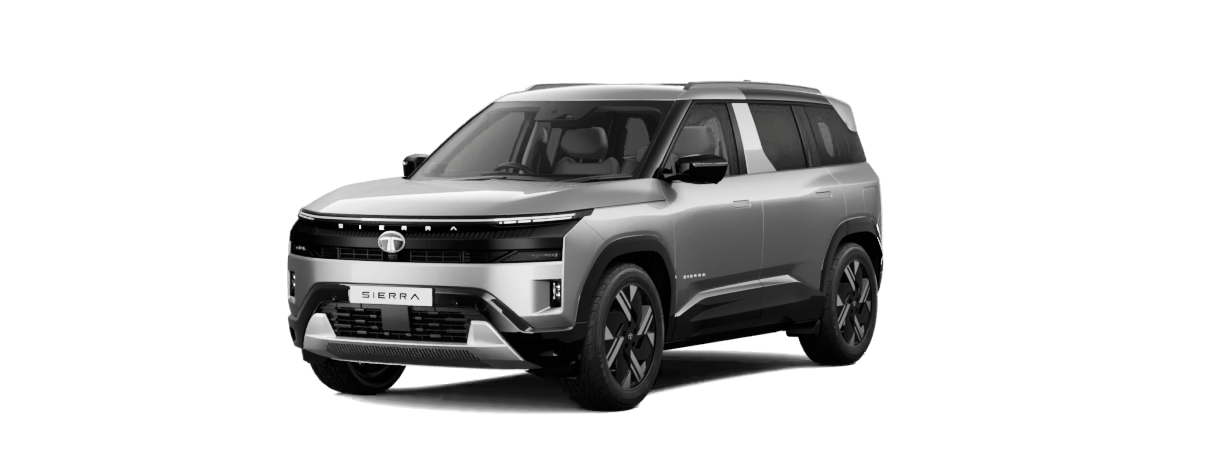
India’s most nostalgic nameplate is making its electric comeback, and the timing couldn’t be sharper. The Tata Sierra EV 2026 launch is set for May 19, and if you’re even remotely considering an electric SUV in the ₹20–25 lakh bracket, this is the one you need to understand before the booking frenzy begins.
Also read about the recently launched BMW M440i Convertible.
What Exactly Is the Tata Sierra EV?
The original Sierra, that boxy, distinctive 3-door SUV with its iconic glass panel rear, was discontinued in 2000 after a legendary run. Tata Motors has decided to resurrect the name, but this time as a full battery-electric vehicle built on its modern EV architecture. The Sierra EV is not a retro toy designed for nostalgia clicks. It’s a proper mass-market electric SUV aimed squarely at buyers who want something that looks different from every other Creta/Nexon clone on the road.
Think of it this way: if the Tata Curvv EV is Tata’s answer to mainstream coupe-SUV buyers, the Sierra EV is for buyers who want character. That’s a deliberately small but deeply passionate group, and Tata knows it.
Design: Does It Actually Look Like the Old Sierra?
Yes and no. Tata has kept the spirit alive, most notably through a distinctive fixed glass panel in the rear, which was the original Sierra’s defining visual signature. The rest of the body has been modernised significantly: clean EV-style fascia, flush door handles, and a silhouette that sits between a traditional SUV and a crossover. The retro cues are there if you look for them. If you don’t, you still get a good-looking electric SUV. That dual appeal is smart product design.
Expected Price: What Will It Cost Indian Buyers?
This is where it gets interesting. Based on Tata’s current EV pricing strategy, where the Curvv EV starts at ₹16.99 lakh (fresh variants launched May 4, 2026) and the Nexon EV holds the entry EV position, the Sierra EV is widely expected to be positioned in the ₹22–27 lakh range, ex-showroom. That places it above the e Vitara and the Toyota Ebella, but below the Mahindra BE 6 and the MG Windsor EV’s upper trims.
If you’re a buyer in Pune or Bengaluru who has been looking at the Creta Electric but wants something that’ll actually turn heads in a parking lot, the Sierra EV’s pricing is going to hit the sweet spot.
Range and Battery: What the Numbers Suggest
Tata has not officially confirmed final range specifications for the Indian market ahead of the May 19 launch. However, the Sierra EV is expected to offer battery options broadly similar to those in the Curvv EV, likely a 45–55 kWh primary pack with a range of 400–500 km under ARAI conditions. Real-world range in city driving (Bengaluru or Hyderabad traffic, AC running) would realistically be in the 320–370 km band, which, for most urban Indian buyers, covers five to six days of daily commuting without a charge.
A 7.2 kW AC home charger would juice it overnight. That’s the scenario most Sierra EV buyers will live in. For a family in a metro apartment with a dedicated parking bay and charger access, the numbers work.
How It Stacks Up Against May’s Other EV Launches
May 2026 has thrown up an unusually competitive EV market. The Toyota Urban Cruiser Ebella is incoming, the Maruti e Vitara is already live at ₹15.99 lakh, and the Tata Curvv EV just got new variants. The Sierra EV will need to differentiate itself on more than nostalgia.
Here’s the honest picture: the Sierra EV’s actual rivals are not the e Vitara (different price band) but the Hyundai Creta Electric and the MG ZS EV. Against those, it brings a more distinctive design and Tata’s established EV after-sales network. What it may lack is the Creta Electric’s feature list at equivalent prices, that battle will be confirmed only at launch.
What This Means for Indian Buyers
If you’ve been sitting on the fence about going electric, the Sierra EV is worth waiting for, specifically if design matters to you. The Indian EV buyer in 2026 is no longer just a tech-early-adopter. With April 2026 total industry dispatches crossing 4.41 lakh units (25% year-on-year growth), more mainstream buyers are entering the mix, and they want vehicles that feel like genuine choices, not compromises.
The Sierra EV makes the electric option feel like a genuine desire rather than a sensible but boring decision. And in a market flooded with me-too compact SUVs, that distinction carries real weight.
Our Take: Book, Wait, or Skip?
Don’t book blind. Wait for the May 19 reveal to confirm actual battery options, charging specs, and variant-wise pricing before putting down a booking amount. What we’d suggest: if the base variant lands under ₹23 lakh with a 400+ km ARAI range and a usable feature set, it’s a compelling buy for anyone who wants an electric SUV that doesn’t look like every other electric SUV. If the top variant touches ₹28 lakh or beyond, the Creta Electric’s value case becomes hard to ignore.
Watch the May 19 event carefully. The Sierra EV’s positioning on that single launch day will tell you everything you need to know.
— Manav Akbari, TheWheelFeed
