
Tata Tiago EV vs MG Comet EV 2026
The budget EV hatchback space in India has three names right now: Tata Tiago EV, MG Comet EV, and Citroen eC3. And honestly, they are not even competing for the same buyer. The Tata Tiago EV vs MG Comet EV 2026 comparison sounds straightforward on paper, but once you add the eC3 into the mix, a pattern becomes very clear. One of these is the obvious choice, one has a very specific use case, and one is still searching for an audience.
Here is what the honest picture looks like.
Also read about the Maruti Fronx vs Nissan Magnite 2026.
The Tata Tiago EV: India’s Most Trusted Budget Electric, Now With a Better Cabin
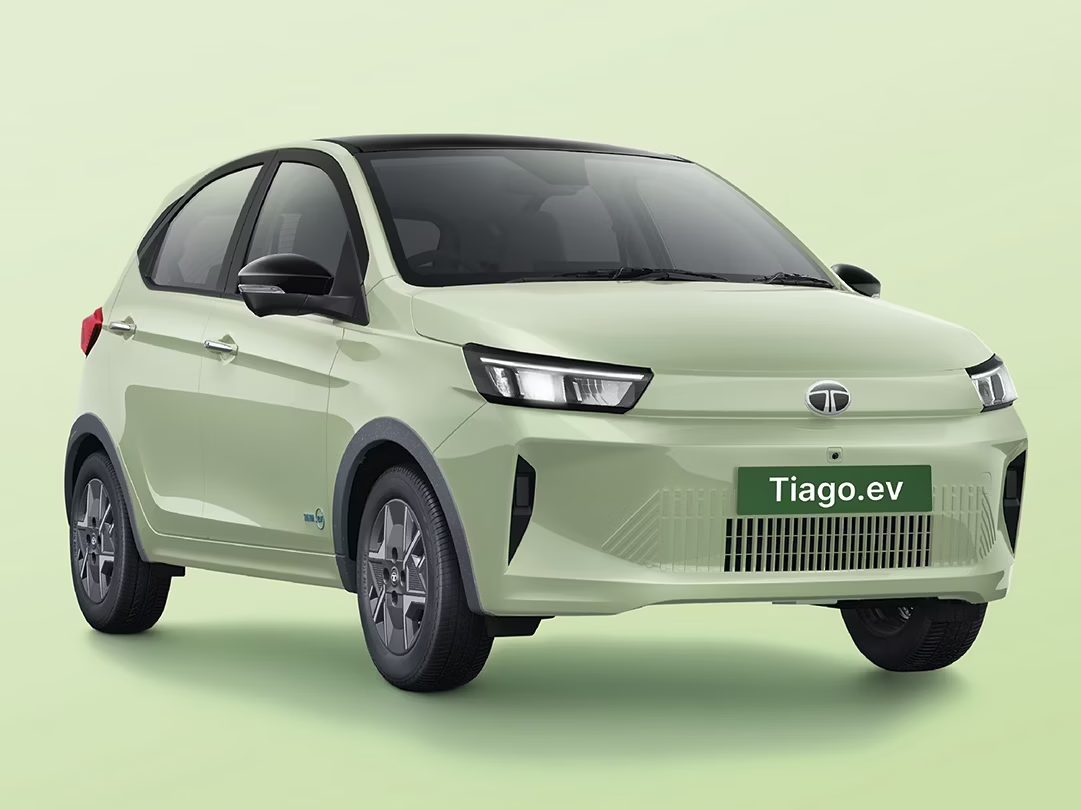
The Tiago EV has been doing what most affordable EVs in India fail to do: it actually sells. Month after month, it sits comfortably as one of the top choices for first-time EV buyers, and for good reason. It is practical, it is backed by Tata’s growing service network, and it comes with the kind of real-world range that makes it usable for daily city commuting without constant anxiety.
Now with the 2026 facelift launching on May 28, the Tiago EV gets a proper upgrade. Dual floating screens, a redesigned cabin with rear AC vents, wireless charging, a 360-degree camera. Features that were unthinkable at this price point even two years ago. Expected prices start from around ₹8 lakh and go up to approximately ₹11.5 lakh depending on the battery pack. That is not cheap for a hatchback, but for what you are getting, a complete, practical, daily-use EV with a trusted badge, it makes a strong argument.
The real-world range sits around 200 km on the larger battery. That is enough for most Indian city buyers who clock 30 to 50 km a day and charge overnight.
The MG Comet EV: Perfect City Car, But Only If You Know What You Are Getting Into
Let us be straightforward about the MG Comet EV. It is not a bad car. It is actually a genuinely clever product: compact, easy to park in tight Mumbai or Bengaluru streets, and cheap to run. Priced between ₹7 lakh and ₹9 lakh, it is one of the most affordable EVs you can buy in India.
But here is the problem. The Comet is a two-seater. The moment you need to take a colleague, drop your kids to school, or fit a piece of luggage properly, the Comet starts to struggle. It was never designed to replace your everyday family hatchback. It was designed as a second car, a city runabout, a vehicle for the person who does 20 to 25 km daily and needs something to zip through traffic without breaking a sweat.
If you commute solo from Andheri to BKC every day and park in tight spots, the Comet is genuinely brilliant for that use case. But if you are reading this looking for a proper alternative to your current petrol hatchback, the Comet is not that. It is not as practical as the Tiago EV, and it never claimed to be.
The Citroen eC3: A Car With Potential That Keeps Arriving Late
This is where it gets a bit uncomfortable. The Citroen eC3 has a legitimate spec sheet: claimed range of around 320 km on a full charge, decent cabin space, and a price in the ₹11 to ₹12 lakh range. On paper, it can hold its own against the Tiago EV. Yet it hasn’t cracked meaningful volumes since launch, despite overlapping directly with the Tiago EV’s top variants on price.
But Citroen has a problem in India that a spec sheet cannot fix: trust. The eC3 comes from a brand that has struggled even with its ICE cars like the C3, which despite being well-built has never cracked mainstream volumes in India. Buyers in this segment are not just buying a car. They are buying into after-sales support, resale value confidence, and a service network they can actually find in their city.
The Tiago EV wins all three of those comparisons without even trying. The Citroen eC3 is the kind of car enthusiasts appreciate but real buyers hesitate on. It has the capability. It just cannot shake the same story that followed its petrol siblings. Until Citroen builds more brand equity in India, the eC3 will remain an underdog, not a frontrunner.
Real-World Buyer Scenario: Who Should Buy What
Say you are a family of three in Pune, doing around 40 km a day, and this will be your primary car. The Tiago EV facelift is the answer. Overnight charging, enough range, a proper cabin that no longer feels like an afterthought, and Tata’s service network to back it up.
Say you are single, working in a tech park in Hyderabad, and you already own a car. You just want something cheap and small for your daily commute. The MG Comet EV makes a lot of sense. Low running costs, easy to park, and perfectly sized for solo use.
For anyone hunting for an affordable electric hatchback in India under ₹12 lakh, the shortlist is short. And the Tiago EV leads it.
What This Means for Indian Buyers
The affordable EV hatchback category is growing fast, but not every car in it deserves equal consideration for every buyer. For most buyers looking at EVs under ₹12 lakh in India in 2026, the Tiago EV remains the default choice. The Comet has its lane and should stay in it. And the eC3 is a decent product that Citroen simply has not earned the right to sell at scale yet in India.
Final Verdict
The Tata Tiago EV facelift is the default winner in this comparison for anyone buying their primary car. It has the trust, the practicality, and now, finally, a cabin that feels worth the price. The MG Comet EV is genuinely great, but only if you are honest about needing a second city car and not a replacement for your daily driver. The Citroen eC3 has specs but lacks the brand backbone India’s EV buyers are still demanding. In the Tata Tiago EV vs MG Comet EV 2026 battle, Tata wins clearly, and the eC3 needs a few more years before it can truly challenge.
Frequently Asked Questions
Which is the best budget electric hatchback in India in 2026?
The Tata Tiago EV is the better all-round choice for most buyers in 2026, especially with the new facelift. The MG Comet EV is a strong option only if you specifically need a compact city commuter and do not require rear seating.
What is the price of the 2026 Tata Tiago EV facelift?
The 2026 Tata Tiago EV facelift is expected to be priced between ₹8 lakh and ₹11.5 lakh (ex-showroom), depending on the battery pack and variant. Official prices will be announced at launch on May 28, 2026.
Should I buy the Citroen eC3 or stick with the Tata Tiago EV?
On paper, the Citroen eC3 offers competitive range and cabin space. However, for most Indian buyers, Tata’s stronger service network, resale value, and brand trust make the Tiago EV the more practical and safer long-term choice.
How much real-world range does the Tata Tiago EV offer?
The Tata Tiago EV delivers around 200 km of real-world range on the larger battery pack. For daily city commutes of 30 to 50 km with overnight home charging, this is more than adequate for most Indian buyers.
Stay tuned and follow up for more.
